some image

Having fun, writing about the stuff I like

A Royal Feast of Racing

Oscar Foulkes June 22, 2012 Uncategorized No comments

It’s not yet over, but I have been utterly captivated by Royal Ascot this week. You could certainly say that it’s been a hugely pleasurable experience (which is what this blog is all about).

During the course of last year, frustration about the generally crap state of horse racing in South Africa amidst a cloud of apparent inaction and apathy led me to jot down a few thoughts on positive steps that could be taken (read them on Sporting Post here).

I’ve been watching the action at Ascot on telly, so I can’t comment on the on-course experience. However, the quality of the broadcast has been excellent. The visuals have been great throughout. Horse racing has plenty of eye candy, from horses to people, who in the case of Royal Ascot have to abide by a strict dress code, which adds to the spectacle.

What really sets the broadcast apart is the degree of knowledge and general interest factor imparted by the presenters. They know what they’re talking about and they make it their business to draw viewers into the drama of the contest. They do get technical when they need to, but it is done in a way that enriches both experience and understanding.

I am going to be accused, I suspect, of being a little disingenuous, because when Frankel steps onto a racecourse, as he did at Ascot on Tuesday, nothing else really matters. I doubt there’s a superlative that hasn’t been applied to him; without being guilty of hyperbole I can say that it’s probably all true.

At the end of his three-year-old career I did a little post about Frankel (here). He won his 2012 season-opener easily enough. What he did on Tuesday, to record his eleventh win, from as many starts, was to completely crush his opposition. I have seen horses win races by 10, 15 or 20 lengths. What one hardly ever sees is that kind of dominance in a Group One race, when the opposition comprises really good horses.

Frankel’s 11-length romp equates to 22 lbs (over 1600m each length of a horse is equivalent to 2 lbs). In other words, if a handicapper wanted a dead-heat, Frankel would carry 22 lbs more than the horse who came second. That’s not much shy of two stone, and even a stone (14 lbs) is a huge differential.

OK, so what else has been good? I’m of the view that bookmakers damage horse racing. Racing constituencies that operate on the basis of a tote monopoly are in better financial health than ones that have a mixture of bookmakers and tote. Having said that, British bookmaking firm William Hill sells bets with far more nous and creativity than any tote I’ve encountered. Creating and making sales offers has formed a huge chunk of my work life, so while it would be stretch for me to call myself an expert, I reckon I can spot the good from the bad.

A couple of months ago I downloaded the Racing Post iPhone app by way of some research into horse racing apps. It wasn’t my initial intention, but with William Hill offering a £25 free bet for sign-ups via the app, how could I refuse? They’re also proactive in occasionally offering app-only free bets if your selection finishes second to the hot favourite in a particular race.

The real point of Racing Post, though, is the quality of the comment. In a free app I can’t expect to get all the detail of the race form, but they give a useful summary of each runner’s chances, along with the all-important RPR (Racing Post Rating), which drives their predictor (see below). This is never going to be right all the time, but it does indicate which horses are best off at the weights.

Racing Post's Predictor for today's King Edward VII Stakes. Astrology is rated 7 lbs superior to Noble Mission and Shantaram, which should see him home by more than a length, but the softness of the ground could have an impact, and these are all young, improving horses.

By using a combination of BBC coverage and the free Racing Post app, I’ve managed to keep my (small) bets this week fun and profitable, mainly by finding horses at 6-1 and better for each-way bets (Joviality, who took the Windsor Forest Stakes at 11-1 was the best example). It helps, of course, that top horses in top races generally run to their form.

My each-way on Opinion Poll in the card-heading Ascot Gold Cup yesterday almost ended famously. He finished second to Colour Vision (so, the place part of the each-way paid out). However, he had been bumped by the winner twice in the final furlong, which resulted in an inquiry. I was amazed that the television cameras followed the jockeys into the inquiry room. This kind of transparency is way overdue in horse racing.

Of course, the week isn’t yet over. Tomorrow we’ll see Black Caviar, the Australian mare unbeaten from 21 starts, in action in the Diamond Jubilee Stakes. All her wins have been on home soil, so she tackles properly international competition for the first time.

It has been an extraordinary week of horse racing, in so many different respects. The sport needs more of this.

(To be read in conjunction with the following post).

Bidding to be Ultimate Braai Master

Oscar Foulkes May 23, 2012 Uncategorized 3 comments

There’s a theory that the Neanderthals died out because their failure to discover cooked food ultimately led to malnutrition. One would assume that food was first cooked over coals or flames, which means that every time we haul out our Webers we are commemorating the extinction of humanoids who never learnt to braai.

While much of what happens around the stereotypical Sunday braai may appear to be somewhat uncivilised, there is something primally satisfying about using this most basic of cooking methods, even if only to grill some sausage (which for many Europeans is as adventurous as barbecues get). Perhaps this is the reason why braai is seen as being inherently unsophisticated. Nourishment without the finesse or artistry we demand of cuisine.

Cooking is about using the best of ingredients, sympathetically seasoned, and prepared with the appropriate degree and type of heat. Not all foods are suitable for braai, but in many cases the results of cooking over coals are unrivalled. Beyond this, it’s excellent whenever one is lacking kitchen space.

However lyrical one may get about cooking on coals, though, it’s just another heat source, albeit one requiring more ‘feel’ to manage than a convection oven or gas hob.

The logo that Nic Jooste knocked together for us

Last weekend I took part in the Cape Town auditions for the Ultimate Braai Master reality show and competition. My ‘braai buddy’ for the competition is my brother, Christopher, and our team is called Hout Cuisine (for those of you who don’t understand Afrikaans, ‘hout’ is wood).

The format of the show is a series of 13 challenges that are spread across 52 days, during which the teams will cover 8000km by road. Justin Bonello, who presents the show, will certainly be including his favourite parts of southern Africa in the route. There is no doubt that he will also be fiendish in the challenges he sets.

Our menu for the Ultimate Braai Master auditions (yes, I know there's only supposed to be one 'P' in tapas).

At the heart of this challenge is an examination of what braai really means to South Africans. It is, after all, held up as an important part of our heritage, and one of few which is common to South Africans in a politically neutral way. The food that our little team presented was completely different to what other teams had done, as you can see from the image below (for fear of accusations of immodesty I won’t repeat what the judges said to us).

So, what is it that makes braai special, even if the meat is burnt? I think it all comes down to the circumstances under which we braai. Basically, braai is done during downtime. We’re relaxing, we’re being sociable, and the whole thing is bound to be very informal.

The other common feature is that men take control of the tongs, which brings with it enough psychology to fill a doctoral thesis. Ultimate Braai Master will decide – once and for all – who really does know his way around a grill. Boys will be boys.

Follow up: I can report that team Hout Cuisine has been selected as one of the 15 teams that will take part in the reality TV show and competition. You can follow us on Facebook.

Delivering, whatever it takes. Really?

Oscar Foulkes May 15, 2012 Uncategorized No comments

During Helen Zille’s State of the Province address earlier this year she announced some ambitious targets for rolling out high-speed broadband across the Western Cape. I think it’s a great initiative, which will be beneficial to both business and education.

One of the obvious ways in which the internet supports business is through ecommerce, a lot of which – admittedly – involves digital delivery (e.g. music, software or books) or the sale of tickets (i.e. airline, theatre etc). However, a sizeable chunk of online purchases are physical items that need to be delivered. In a time of Facebook, Twitter, and other cutting-edge tech applications, physical delivery is a seriously mundane concept. In fact, it’s so mundane that ecommerce insiders even have to resort to jargon – fulfillment – rather than call it what it is.

Word from commercial real estate in the UK is that retailers are shifting investment from high street stores to warehouses supporting online retail. To borrow from the title of a popular book a few years ago, there’s a lot of cheese being moved.

I always tell my clients that the perfect physical item to sell online is high value and light. That way one can afford to sell with free courier delivery. The reality is that much of what is sold online is both low value and relatively heavy or bulky. For these items the Post Office offers the most practical solution.

I’ll give you an example: as long as the dimensions fit within prescribed parameters, and the item weighs less than 1kg, the Post Office will send it counter-to-counter for around R20. Via courier, the same item can cost up to R100 in metropolitan areas, and up to double that in outlying areas. Yes, it’s possible to negotiate the courier fees, but they will remain many multiples of R20.

While the Post Office’s letter business was killed by email, the internet has created an entirely new one in the form of delivery of online purchases. It’s a hugely important role, both for existing businesses, and for ones that are yet to be founded.

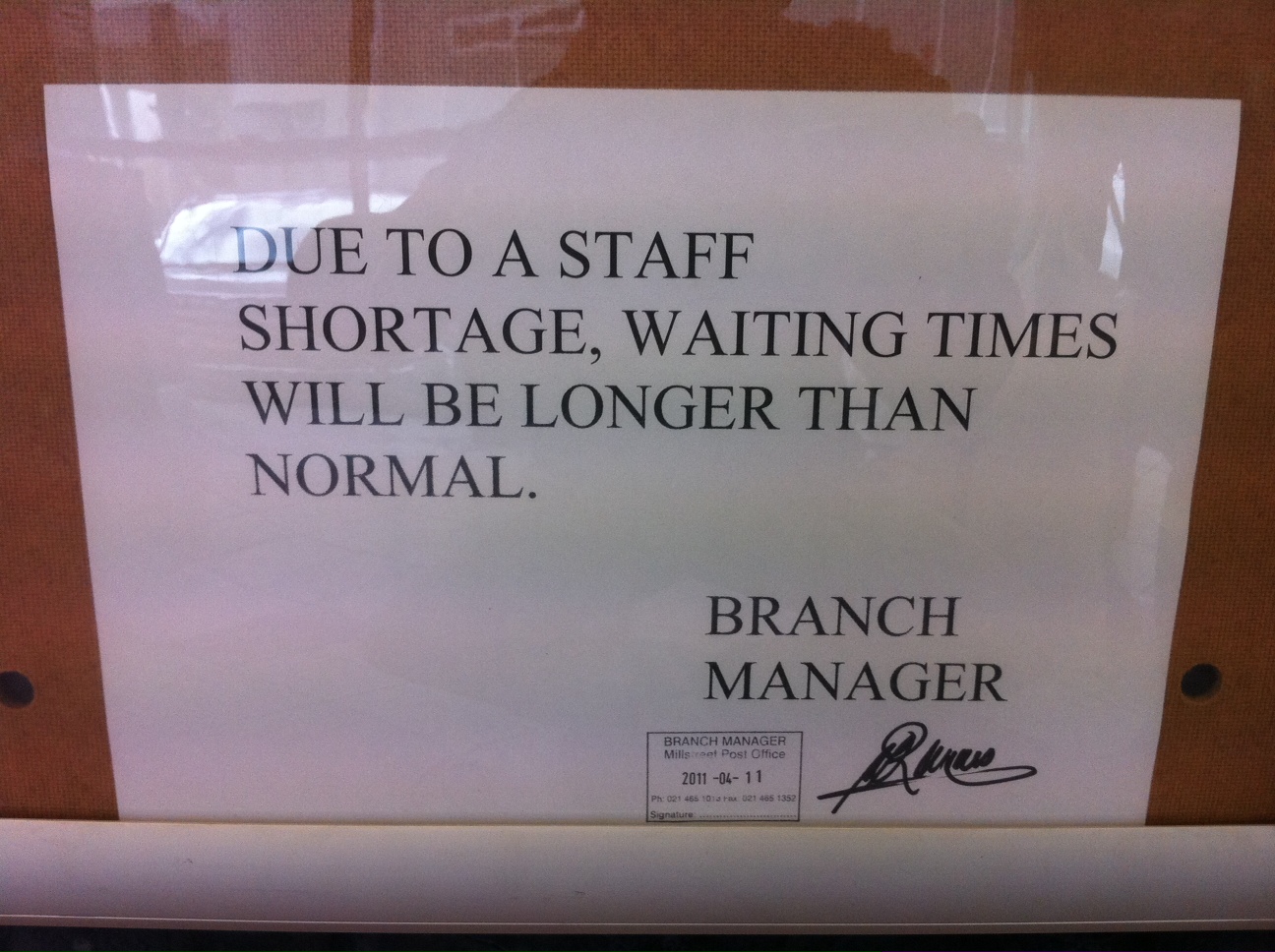
Sadly, the Post Office has no sense of its importance to the economy, or, if it has, it’s doing an excellent job of keeping it a secret. The Post Office – in my experience – is without peer in its depths of utter uselessness to fulfill even its most basic mandate. This is an organisation that is dysfunctional, with a capital D.

For starters, there is no guarantee that your local branch will have the particular stamps you need (imagine going to KFC, only to be told that they have no chicken). The special boxes for the under-R20 shipments are rarely in stock, along with various other articles essential for the postage of an item, either locally or overseas. Systems and procedures vary from branch to branch.

Bulk postal drops have to endure the same interminably long queues as people collecting their pension payout. In Cape Town, Cape Mail is the only option for bulk drops. However, Goodwood/Epping is not necessarily cost-effective or convenient for many businesses.

Once the item has been passed over the counter (to a well-meaning and usually helpful employee) a further sequence of frustrations await. These, admittedly, apply mostly to international parcels sent via surface mail, which are then sent to Durban to await a ship. This wait can be two months, or occasionally, forever.

All the while the online retailer has to placate increasingly irate overseas customers. Calls to Post Office customer service can take an hour to be answered, and their online tracking facility is often not operational. Someone commented on Twitter last year: “How can the Post Office deliver letters if they can’t even deliver a web page?”

Interesting-looking items without a tracking number are often targeted by light-fingered employees. For example, I developed a special package for NoMUshop.co.za that qualifies as a letter, and can therefore be sent cost-effectively via airmail, anywhere in the world. The problem is that some of these envelopes go missing.

So, you can see, there are many ways in which the Post Office frustrates the efficient and effective functioning of businesses that are trying to grow. This beast desperately needs to be fixed. I do need to stress that the individual employees manning the counters, in the majority of cases, try very hard under difficult circumstances, but there is only so much they can do if the entire organisation is broken.

In his fabulous book, The Quest, Daniel Yergin quotes Andris Piebalgs (on energy efficiency) as saying: “It’s very important [for politicians] to be able to cut a red ribbon.”

I think that quote is pertinent with respect to the Post Office. Fixing it doesn’t give politicians photo opportunities at a ribbon-cutting ceremony (like opening the Gautrain, or a new airport building, for example), but it’s just as important for business.

Five years ago I went to a lot of trouble to make contact with the leadership of the Post Office, because I thought that its branches were the most underexploited retail space in the country (and I thought I could improve it). I still think that, but I have subsequently learnt that the problems on the other side of the Post Office counter make its retail underperformance appear quite trivial.

Getting South Africa working isn’t just about large projects. Sometimes, the first step is to get some basics right. The Post Office is an excellent place to start.

Shaving the Razor Budget

Oscar Foulkes February 17, 2012 Uncategorized No comments

Fifteen years ago, I visited a barber shop in San Gimignano, where I treated myself to a proper, old-fashioned shave. The man wielding the cutthroat spent the entire time conducting a conversation with his waiting customers, apparently maintaining eye contact with them throughout. You can imagine that this was quite nerve wracking for me, although less so than if I had been in a more bloodthirsty part of Italy.

Shaving in the modern era is quite different. A couple of years ago, I wrote admiringly of the efforts by Procter & Gamble to increase the sales of its Gillette products in India. While price (which they irritatingly trimmed to a quarter of the price in South Africa) was a consideration, the biggest issues they faced were religious and cultural.

For the purposes of that piece I was able to observe the exercise objectively, from the perspective of a marketing practitioner. However, as a consumer, I find it impossible to be objective about Gillette.

I don’t buy into conspiracy theories. There is no cabal of elites pulling the marionette strings on what happens all around the world. However, when it comes to the cost of shaving, there is a pretty good equivalent, in the form of Gillette.

Let’s first get the shaving foam out of the way. As a child, I thought the foam was there to show my father where he still needed to shave. The adult me knows that the lubrication makes the shave more comfortable. However, there are various ways of achieving the same effect, with humble bath soap doing a perfectly good job. Legend has it that Einstein had the same view on the matter.

I think we’re all agreed that the safety razor was an advance on the old cutthroat, and that swivel head, multi-blade razors are a further improvement. But, for eff’s sake, do we really need five blades on the damn things?

This is the basis of Gillette’s bid for world shaving domination. Every few years they change the technology, which not only gives them an excuse to increase their prices, but also traps consumers because the blades are designed to fit specific generations of the razors.

While there may be special offers on the new razors (with a token number of blades), special offers on blades alone are rare. At most, they’ll toss in some shaving foam. And, with the level of shoplifting of blades, supermarkets now keep the blades behind a special counter. So, it gets harder to spend a few minutes deliberating your options before making a purchase.

A couple of months ago I switched to Schick. The blades are almost half the price, and give me a perfectly smooth shave. In my cupboard I also have two generations of Gillette razors, which enables me to take advantage of special offers, should they ever materialise. But, with just two brands on the shelves, price discounting seems a remote prospect.

The options in disposable razors appear to be greater, but apart from the sub-standard experiences I’ve had with disposables, I just can’t cope with the concept of dumping that much plastic.

Why don’t we have more competitors in this arena? Surely the technology isn’t that difficult to replicate. I suspect there are two main barriers to entry. The first comes in the form of the hundreds of millions of existing razors, for which men unthinkingly simply buy replacement blades every month, or two.

Retail distribution is factor number two. The new brand is going to be dead in the water without shelf space.

Finally, while extortionate, the price of blades isn’t high enough to incite revolution amongst consumers. A monthly cost of something between R20 and R50 is irritating, but not a significant enough chunk of anyone’s household budget.

So, unless a bold entrepreneur leaps into the market, we’re stuck with the two brands.

(Apologies to women; I know that we men aren’t the only customers, but most of us shave every day. While we have the choice of not shaving (like you), waxing our faces is not an option. Ouch!)

I’ve subsequently discovered exactly the “bold entrepreneur” I referred to above. Their deal is based upon 4 blades per month, which is faster than I use them, but I can’t fail to be impressed by their sales pitch. Check out this video they posted on YouTube:

In Praise of Square Pegs

Oscar Foulkes February 15, 2012 Uncategorized No comments

I happened to be looking yesterday at the staff complement of a hugely successful investment banking business. Well, my visit to their website wasn’t entirely coincidental, because I wanted to pitch an idea to one of their team.

What struck me was the number of them with Accountancy or Law degrees, and how many had done time at PWC. My immediate response was that this was the perfect team for management by Excel. You know, where the entire venture is modelled on spreadsheets, which is all good and well.

The problem is this, no matter how complex the financial modelling, somewhere in the continuum from raw material to consumer someone needs to be creative. Quite a few people, actually.

I had a little moment in which I could see the lopsidedness of their skills base, and how they desperately need to have crazies like myself floating around from time to time (to keep their business plans sane).

Then, this morning I tuned into Sir Ken Robinson’s talk about the way in which education is killing creativity (yes, that’s the video above). I loved the way he describes us as first being educated from the waist up, and then, once the education starts to focus on the brain, all the attention is skewed to the logical, analytical side.

I can be as analytical as any one of the smart-degree types on the aforementioned investment banker’s payroll. The difference is that I am also completely at home operating on the intuitive, or creative side.

The kind of training that gets someone to the point of wearing a dark suit at an investment bank is designed to eradicate any tolerance for ambiguity or grey areas. I know it’s a gross generalisation to suggest that everyone with that kind of training is going to believe only the tangible output of a spreadsheet. To those who have seen the light (or should I say, the grey), I apologise unreservedly.

Professionally, I often feel a bit ‘square-peggish’. The views of Sir Ken would suggest that perhaps it’s the round hole that needs to have a turn at feeling frustrated.

“How’s that” for a relaxing afternoon?

Oscar Foulkes February 15, 2012 Uncategorized No comments

Cricket, even when played by the likes of Merv Hughes, is the most civilised of sports. Yes, the brashness of twenty-over cricket brings a less genteel dimension, but the sound of willow striking a shiny, red Kookaburra (or vice versa) is the most satisfying “thwack” imaginable.

That, and the hopeful shouts of: “How’s that?” are the sounds of a cricket field. Polite claps, following a good shot, or good bit of fielding, or anything else noteworthy, are the aural contributions that spectators make.

One of the benefits of having flexible work arrangements is that I can park myself next to a cricket field once a week, MacBook on lap, to watch my son’s matches.

So, there I was at the first match of 2011, getting busy with some work, when the calm of the charming, tree-rimmed field was broken by a sound that could only have been produced by a cork exuberantly departing a champagne bottle. And so, with the actions of a couple of fun-loving mothers, started a tradition that has continued into a second season (and even gets a mention in the school magazine!).

It may well be indulgent of me to allocate a couple of hours during a workday, and frivolity of the bubbly aside, it’s something that I find hugely rewarding. During the season, the team also managed to finish two matches on tied scores, which were two of the most exciting limited overs matches I have ever watched (internationals included).

And, when either the work or cricket is boring, there is always the conviviality of sharing a bottle of chilled bubbly with other parents.

Holiday Reading

Oscar Foulkes January 13, 2012 Books No comments

For me, holidays are a prime opportunity to pack in a LOT of reading. In previous years I’ve kicked off by diving into a Robert Goddard, or something similar. You know, a plot into which one escapes for a day, or so, and by the time you emerge from the book the daily grind has magically vanished.

This year, I dived straight into the more serious stuff:

The Quest: Energy, Security, and the Remaking of the Modern World, by Daniel Yergin
If you think the title of this book is daunting, wait until you encounter the book itself. Well, I didn’t because I read it on iPad, but it must be quite a tome in physical form. Yergin won a Pullitzer Prize for his 1992 book The Prize (about oil), and he is something of a one-man energy think-tank. I won’t deny that reading the book requires a fairly substantial commitment; apart from its length, Yergin is not the most polished writer around (and, there are irritating errors, like “amuck” instead of “amok”)

The Quest is a bit like a semester course on oil, gas, coal, nuclear, geo-politics, prospecting, renewables, conservation, electricity, cars, and environmental issues. There is quite a large technical component to the book, but Yergin keeps it all interesting by incorporating some fascinating history (and a suprising cast of characters).

Energy, in its various forms, is something we consume – usually without even thinking about it – every second of every day. The world couldn’t be what it is without electricity and our various forms of vehicular transport, all of which require energy.

I give The Quest a definite thumbs-up. It’s worth making the effort to read this fascinating book.

The 52 Seductions, by Betty Herbert
This book is listed in chronological order of reading; there is absolutely nothing that ties 52 Seductions to The Quest. For starters, Herbert is a good – and funny – writer. Secondly, while the title and plot line suggest that sex is the subject, the book is actually about long term relationship, and marriage in particular.

The (real life) story is based upon a pact made by the author and her husband when they realise after 10 years of marriage that they seldom have sex. It’s not as if love has departed the relationship, far from it. No, desire is the missing ingredient. So they agree to take weekly turns at ‘seducing’ each other. Yes, it is a bit of date night with a twist (not all of them have what you might euphimistically call ‘happy endings’), but it’s really about marriage from the woman’s perspective, which is always a good thing for men to know about.

This is a light and easy read, which I’d also recommend.

Even Silence Has an End, by Ingrid Betancourt
By the time I’d finished this book I’d had a rather intense dose of woman-focused literature. Betancourt was a Colombian politician when she was captured by FARC rebels. It’s not that they were targeting her, but once they had serendipitously netted her they weren’t about to release this valuable bit of political capital. This book is about the six-and-a-half years she was in the jungle as their hostage.

She suffered all kinds of abuse – including being chained to a tree by her neck – and deprivations, which at times included a prohibition from speaking, or being spoken to. What preserves her throughout the ordeal is the realisation that, while she is a captive, she remains free to choose how she is going to respond, and what kind of person she is going to be. This is pretty much the same conclusion reached by Viktor Frankl in Man’s Search for Meaning, which deals with his experiences in Nazi concentration camps.

There were so many FARC hostages in various parts of the jungle that one of the radio stations would broadcast messages recorded by friends and family, which they were able to listen to, sometimes covertly. This component made me think of the fixation we’ve developed with various forms of social media, which enable all kinds of conversations to happen. Betancourt was not only deprived of her liberty, but was restricted to receiving one-way communication only.

Betancourt has written a powerful and thought-provoking book, which I definitely recommend.

Chasing the Devil, by Tim Butcher
Butcher has previously reported from Liberia and Sierra Leone. He returns in order to – literally – follow in the footsteps of Graham Greene, who trekked in 1935 from Freetown, through Sierra Leone, into Liberia, then through Guinea, back into Liberia, and then by boat from Buchanan to Monrovia.

When Greene made the trip he was disenchanted with Europeans. He went in search of a kind of simplicity or purity, which he found in the jungle-dwelling Africans. Butcher has a somewhat different interest, in that he is trying to make sense of the extreme brutality and murderousness which characterised the various internecine wars that have taken place in the region over the past couple of decades.

Butcher observes that the jungle is a harsh environment in which to live. The locals’ best chance at survival is to stick together, which usually means towing the ‘bush’ line. Young men are trained – and indoctrinated – by highly secretive bush societies, or cults. In this context, the local tribe will carry far more sway than a distant government administration which makes no positive contribution to people’s lives, and which may in fact make their lives worse, through corruption and discrimination. He makes the (depressing) observation that, in Africa, Africans survive. In order to thrive they need to go elsewhere.

The presence of valuable natural resources has not improved their lives; if anything, minerals have resulted in more misery, as aggressors seek to control the assets.

Butcher is not only a deep an observant thinker, but also an excellent writer. I’ll be making to effort to read his other book, Blood River, soon.

Our Tree-Climbing Dog

Oscar Foulkes December 20, 2011 Uncategorized No comments


I previously did a post about our three Weimaraners (here). The puppy, Oliver, has grown up into a seriously athletic dog, who has his own set of idiosyncrasies.

We couldn’t understand how he kept escaping, until we caught him in the act!

“One thing”

Oscar Foulkes December 17, 2011 Uncategorized No comments

This scene, from the movie City Slickers, is one of the few bits of a movie that I can remember vividly. I suppose it addresses something I’ve always struggled with, given my wide range of interests, and I often think of it.