
The premise of Oscar’s Pleasure is in the name, both the things or experiences that bring me pleasure, and in writing about them. With this in mind, considering how big a part Thoroughbreds play in my life, I’ve written very little about them.
My experience of Thoroughbreds has many layers, so I’m going to dip into them using a few headers to thread my way through the implicit complexity. Before I get to that, the starting point is what it does for my soul to be with the horses on our stud.
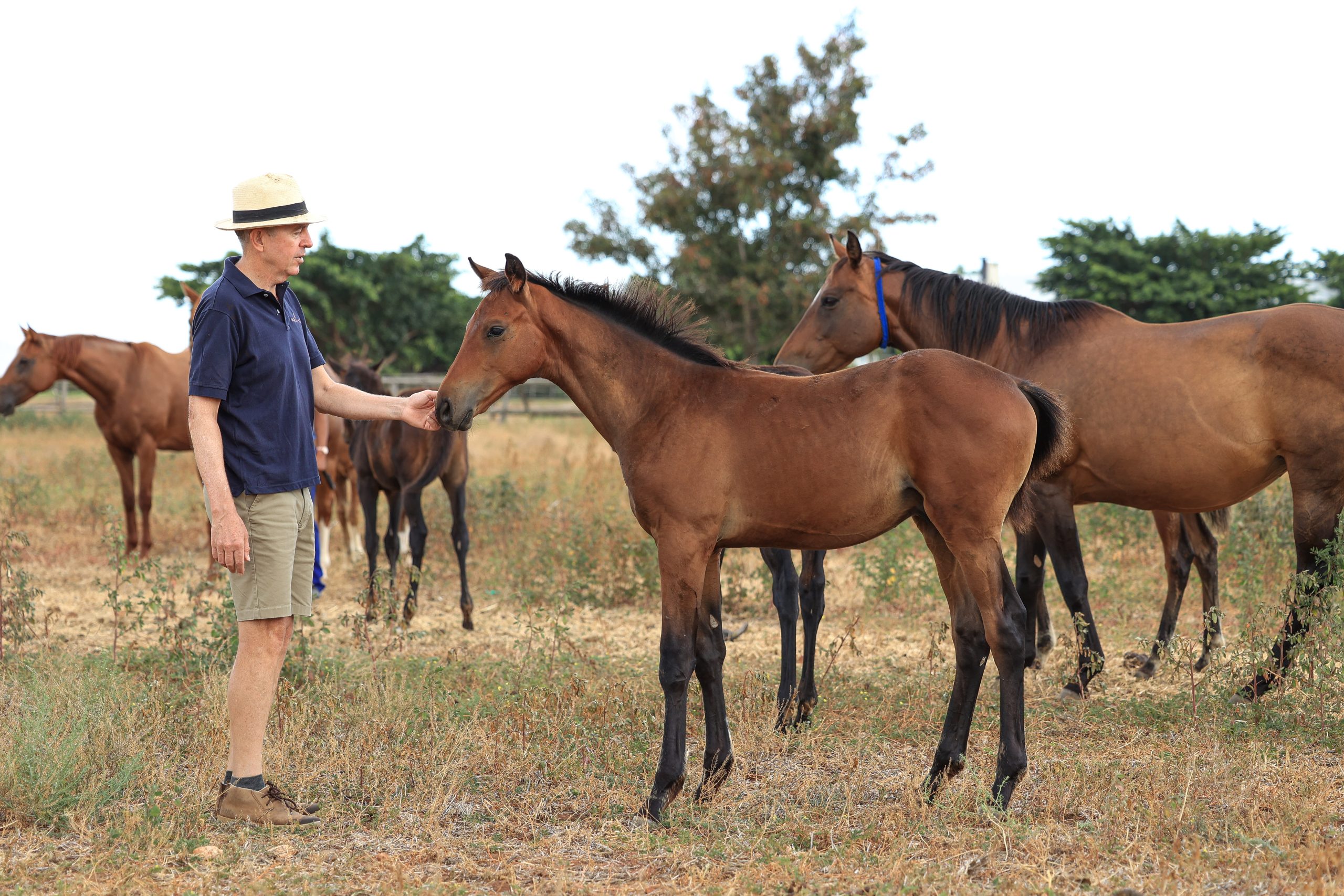
I cannot think of a better workday than stepping out of my front door as the sun is rising, to walk through all the paddocks to check on the horses. The youngsters – weanlings and yearlings – are a particular treat, because they are inquisitive creatures who crowd around me, demanding attention. I love the physical closeness with them, each a different personality. When I move onto the next paddock, some of them will follow me until I reach the fence.
It’s not possible to spend time with them and not also imagine what glorious victories might await them. We breeders live in hope!
The Breed
The three most important foundation stallions were Arabians imported to Britain between 1689 and 1729, with the first Stud Book being published in 1791. Thoroughbreds are unique amongst domesticated animals in that they are bred for athletic performance. Italy’s greatest breeder, Federico Tesio, is often quoted: “The Thoroughbred exists because its selection has depended, not on experts, technicians, or zoologists, but on a piece of wood: the winning post of the Epsom Derby. If you base your criteria on anything else, you will get something else, not the Thoroughbred.”
Despite the historical importance of races like the Epsom Derby, which is run over 2400m, modern Thoroughbreds are genetically specialised to perform at their best over a variety of distances (i.e. sprinters, middle-distance, stayers).
The athleticism and intelligence of Thoroughbreds means that they are also equipped to progress to rewarding careers in other equine sports, or purely recreational riding, when they retire from racing.
Genetics & Genealogy
One of the jobs of a breeder is to match stallions and mares (i.e. the bloodstock) with the aim of breeding superior athletes. Even if all other factors are perfect (to the best of our knowledge), given the unknowns that occur at the moment of conception, we cannot confidently predict the outcome of a mating. The best we can do is expect that excellence will follow the statistical distribution of the sire’s produce record, or of the female family. Despite our best efforts, we’re guessing, although hopefully better than anyone else.
Thoroughbred genealogy (often referred to as pedigrees or breeding) has fascinated me since I was a little boy and will likely engage my brain until it stops functioning. It’s one of the complexities that draws people to the sport/industry.
Racing
You don’t have to be an experienced horse person to be grabbed by the visceral excitement of pounding hooves as gleaming, muscular equine athletes race past you. Of course, jockeys – possibly the world’s most underrated sportsmen and women – are also part of the athletic package.
If you own the winner, even a miniscule share, or you’re associated with it in some other way (e.g. breeder), there is nothing that matches the excitement. The experience is also elusive (refer to my earlier comment about unpredictability), which is one of the reasons why people who can buy any experience are so seduced by the pursuit of owning or breeding champions.
My interest is also an intellectual one; what happens on the racecourse informs my decisions relating to bloodstock.
Every racing jurisdiction has flagship races that determine each season’s champions and watching them is of interest to racing people all around the world, much like major sporting tournaments.
Syndication
Syndicates are a great way to get the excitement (and disappointments) of racehorse ownership by dividing the costs into manageable shares. I put together my first syndicate when I was a university student. Since 2018, I’ve been running them almost continuously on a small scale, which has kept me in contact with the ‘end consumer’ part of the industry, much like my time in wine retail.
Handicapping
I’m using the word handicapping in a British, or golf sense, rather than the American, where its application is the study of form with the intention of placing bets. Newton’s Second Law applies, in that the drag effect of weight is measurable. It’s applied in the weights carried by horses in handicap races, as well as in the weight allowances given to fillies (female horses) when they race against males (colts and geldings). In weight for age (WFA) races, younger horses carry less weight than older horses to make up for the difference in maturity. This allowance varies over different distances and reduces during the racing year. The world’s most important races are either run at WFA for all ages, or at level weights for three-year-olds.
How handicapping plays out is that a lesser horse will carry a lower weight in a handicap race, with the aim of equalising the chances. Champions can carry big weights to victory in important handicap races, with Forego being one of the great examples (he’s worth a Google detour).
Over 1600m, one length at the finish converts to 2 lbs in handicapping terms, extrapolated pro rata over shorter or longer distances. Phil Bull, who founded Timeform, is probably the most respected handicapper of all time. He did a university degree in Mathematics, which says something about the type of complexity awaiting those who embrace this aspect of the sport.
Betting
Betting, rather than the sale of broadcast rights, is largely what pays the bills in this sport. Unlike casino gambling, the role of handicapping and other specialist knowledge means that horse racing is not a game of chance. In all jurisdictions, the policing of racing, through camera angles following runners in a race, as well as dope testing and other measures, ensures that the possibility of activities that could manipulate outcomes are minimised.
I seldom bet, which makes me a boring companion on days at the races, but I have more than enough other angles to keep the afternoon interesting.
Farming
On the farm, apart from the bloodstock, I am also managing pastures, which means that soil health, and the plants growing in it, is an area of particular responsibility and curiosity (read more here). This custodianship feels as if it is as longstanding a commitment as the broodmare band to which my parents laid the foundations over 50 years ago. I find this particularly rewarding.
History
My mother’s family started farming in Ashton in the early 1870s, breeding horses continuously since then. While I’m conscious that I’m doing this with generational knowledge, I’m doing it for myself. It’s not to carry the flame on behalf of a family in which other branches exited the Thoroughbred industry decades ago.
The number of studs that have been at it for multiple generations is small and shrinking. An even smaller number of studs operate purely on the cash flow from breeding. I’m aware that I represent a dying breed, not just as the final Thoroughbred representative of my family.
The Business
This is an industry in which it’s very easy to be distracted by the product. Like wine, shortcomings in financial performance somehow get compensated by unmeasurable rewards. It’s a very, very hard way to make a living. The main reasons for this are the inherent unpredictability, as well as the myriad versions of injury or mortality associated with livestock. Once I’ve got my way past these risks, my financial fate is subject to buyers’ capricious preferences that are similarly outside my control.
It says a lot for the extent of the passion that it has the power to carry me and my fellow breeders through all this. It’s also thanks to this passion that I find it difficult to approach this business purely from the perspective of assessing risk-free return on investment. The passion is both a blessing and a curse.
If things aren’t going well, I remind myself that I’m surrounded by horses, which is an experience that the industry’s clients (i.e. racehorse owners) are spending fortunes chasing. Then I try to think what else could fill my days with as much richness and I’m grateful that I have this opportunity.