
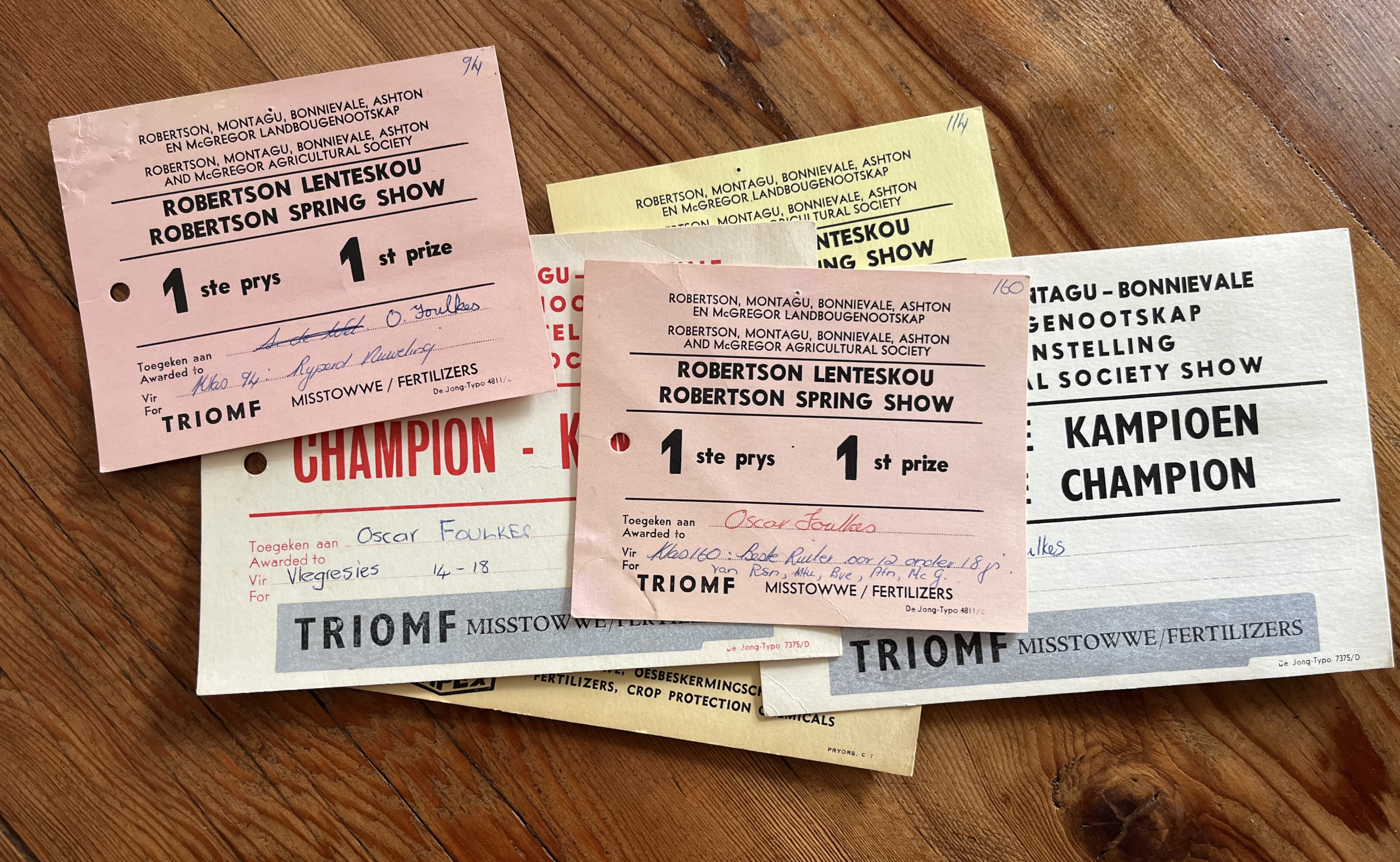
In a few months I’ll turn 60, which means I’ve had four decades of adulthood to collect treasured objects. Even something from my 20s would now be old; if I still had one of the cars from when I started driving, it would be old enough to be a classic. For this week’s treasured objects, horse show prizes, we go even further back in time, to my pre-teen and early teen years.
These prizes are linked to something of a relic in rural living, in the form of agricultural shows. To young Oscar, they were magical annual events in Robertson, bringing together a variety of elements of the agricultural economy and social life. There are two smells that will forever strike an emotional chord for me. The first is the slightly charred smell of chicken legs and thighs being grilled over hot coals by members of the local Round Table. The second was the smell of gleaming new tractors amidst an almost unimaginable cornucopia of agricultural implements. Given that our own tractors smelled of old oil and diesel, this was magical and aspirational in the extreme.
Various livestock were shown, but the animals that interested me the most were the horses. I had some curiosity for the American Saddlers, ridden by serious-faced formally dressed men (and a few women), maybe largely because of the extent to which the horses’ natural gait had been trained into something that was utterly foreign to my experience of horses (click here to see an example from the US). There was also a version of similar horses in harness.
The highlight was that I also got to compete, getting onto the ‘podium’ multiple times, riding ordinary horses that moved in naturally. I suspect I saved all my prizes, and from these it seems that I was judged the best rider aged 12 to 18 (although I may have been younger at the time), along with prizes for the horses I rode. The most fun, though, was gymkhana, in which I won first prize in the flag race (the Afrikaans word, ‘vlegresies’, literally ‘weaving race’, is much more descriptive). Some of these cards still bear my teeth marks; I wasn’t wearing a jacket, so I had nowhere to put my prizes once they’d been handed over by the judges.
There are more important accolades to earn, so why have these ended up as treasured objects? To try to answer this, I need to get back inside the feelings of the little boy (even if the little boy wasn’t necessarily conscious of them at the time).
I arrived at Excelsior, my mother’s family farm, just before I was 17 months old, when my mother left her first marriage, and my brother was about to be born. For several years we lived with my grandmother, as well as my uncles and aunt in what is now the Excelsior guest house. I have happy memories attached to this time, because I’m sure they lavished attention on us. Excelsior was a mixed farming operation, with the usual spread of vineyards and orchards, as well as a Thoroughbred stud. In addition, there were my uncle Stephen’s riding horses.
Stephen taught me to ride when I was four years old, but he also took me on some of his rides. I have memories of sitting on his shoulders while he was on horseback, which now seems like a crazy thing (not to mention the absence of helmets). At the time he would have been in his early 20s, and therefore not yet in command of his prefrontal cortex, with obvious effects on his assessment of risk.
In fairness, Stephen was a most natural and relaxed horseman, riding from the same playbook as Chris Snaith and his son Justin, using examples of horsemen I’ve admired in adulthood. I’d like to think that his horsemanship has informed the way I work with horses now.
Horse riding was a passport to freedom. When my brother was old enough to join me, we rode all over, sometimes playing games that involved us being engaged in a fantasy activity that involved horses. It was happy space, and that was before one gets to the equine therapy angle. Horses are great to be around at the best of times, and in our case, there was also a dose of the less ideal times.
Other than being my conduit to horses, Stephen did something else for me. I have a memory of being very little and lying asleep across the front seat of his Ranchero pickup, with my head on his lap. This bit of reaching back into very little Oscar may be a stretch, but there was no father in my life, which may go some way to explaining why it felt so significant to be physically close to him.
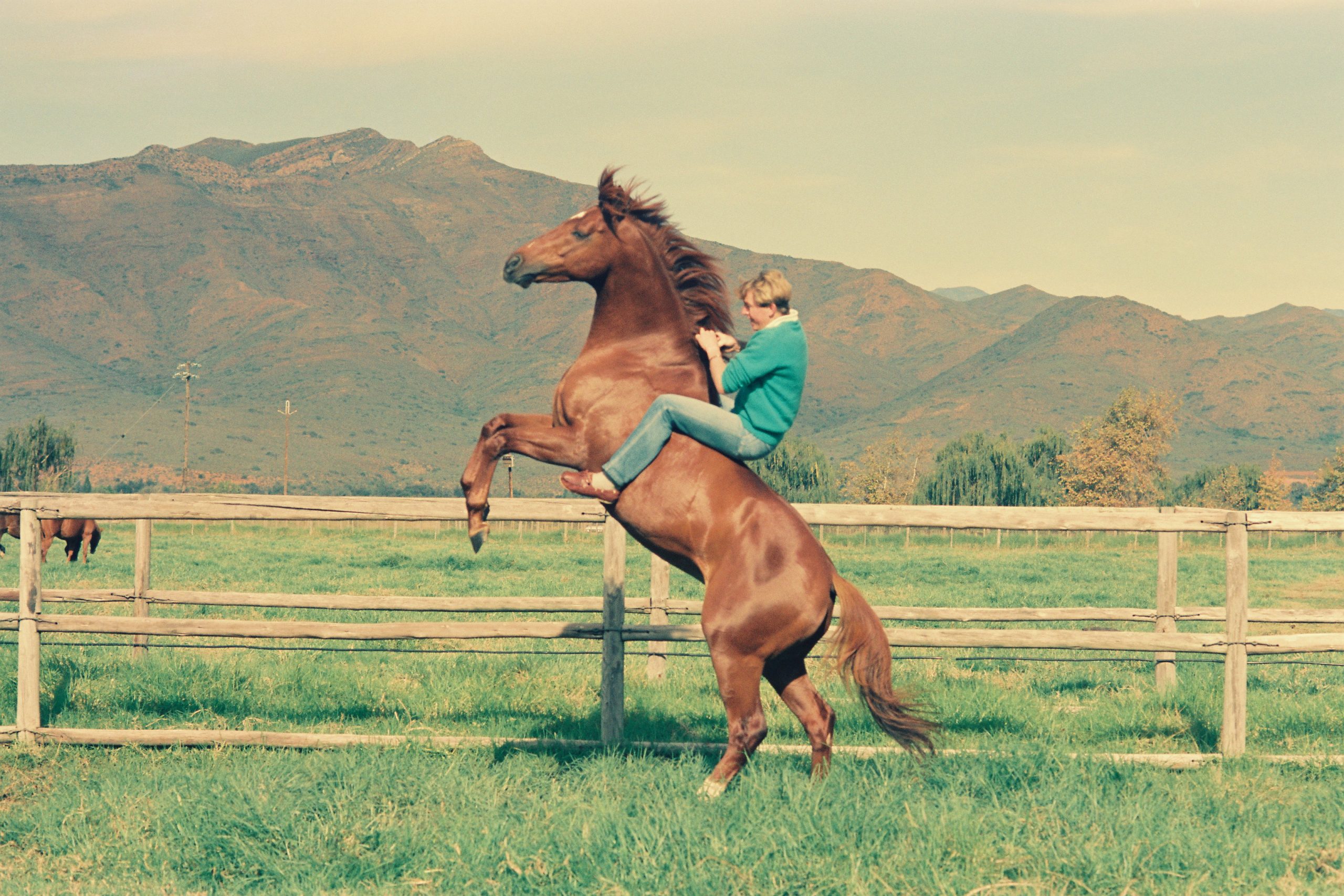
Stephen’s party trick, especially after a Sunday lunch with guests, would be to take them to see his stallion, Beau Charles. To the oohs and aahs of guests, Stephen jumped onto the bridleless stallion in the paddock and rode him around. Years later, when I, too, was in my early 20s, I jumped onto a stallion we were taking a break from photographing. The difference was that Truely Nureyev decided to rear, but fortunately Stephen had taught me well and it all ended safely for both horse and rider.
There is nothing aesthetically impressive about these prizes and there may not have been stiff competition for them. But they gave me a sense of achievement as well as representing the people and the horses who fed me emotionally. Although it all happened a lifetime ago, it was formative in the adult I became.