
In theory, gardening should be easy. For every plant that these days is a crop, there once was the wild version that grew pretty much as a weed (and you don’t see anyone with gardening gloves and a trowel tending to weeds).
For an eating-obsessed household, comprising four adults who love cooking, and where the number of guests is fluid – often counted in units of a dozen – you might imagine that we have a lot of produce entering the kitchen from our own garden. As with many things, the fantasy is so much more alluring than the reality. We grow things that thrive on being treated with benign neglect. Water is generally the most love they are going to get and if they perform well, someone is going to come along with a pair of scissors and reduce them to little more than a stump.
Spinach, parsley (flat leaf, not the St Richard version), basil, various hard herbs, and chilli. These are the plants that grow like weeds in our garden. Dust to dust, weeds to weeds.
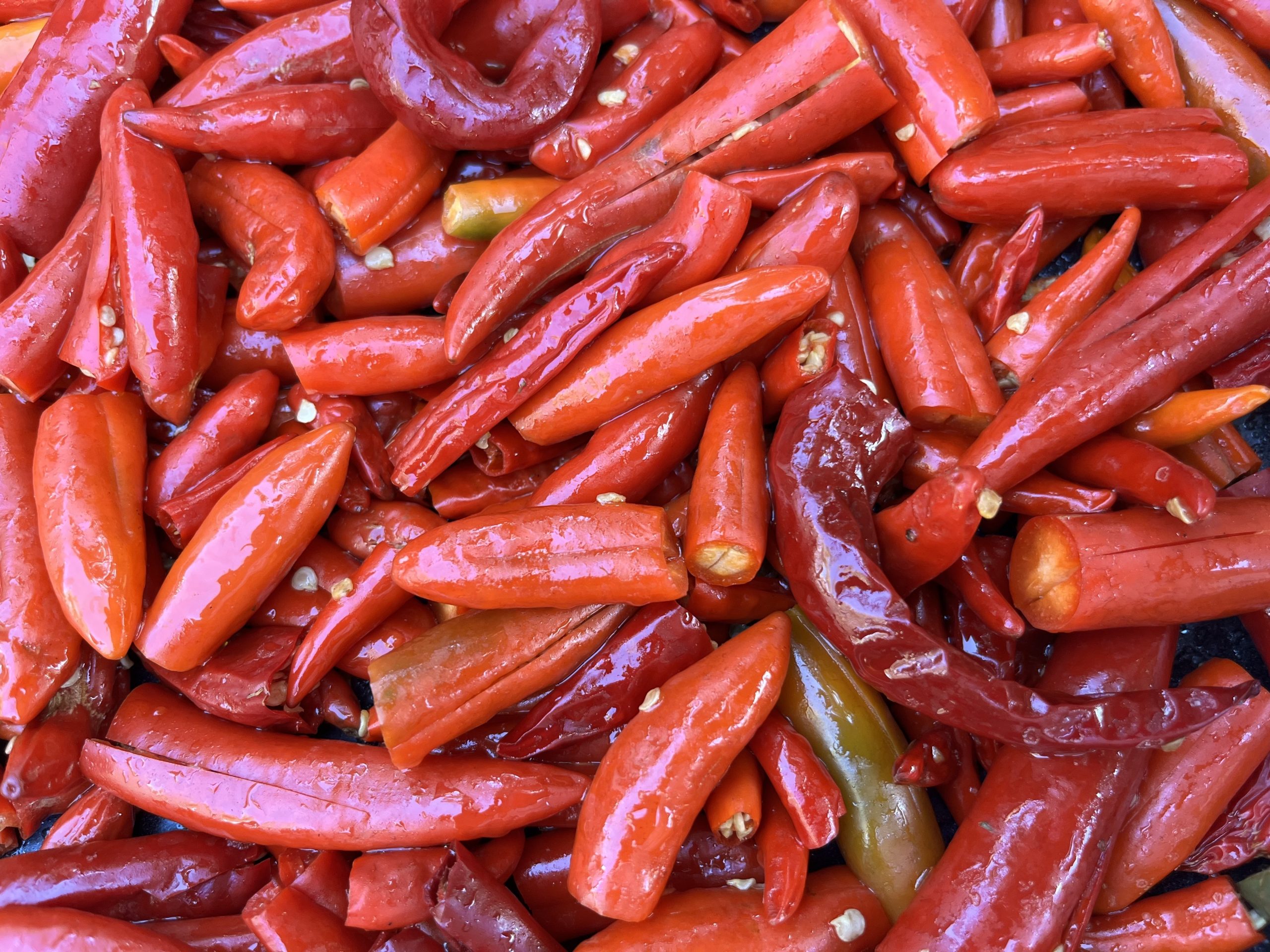
A variety of chillies have taken up residence here, some planted and the rest propagated from seeds dropped by previous crops. An unknown number of these are our own backyard hybrids, mixed breeds for want of a better description, growing in an assortment of mismatched pots and odd patches of soil so disorganized that one wouldn’t be wrong in describing our garden as a favela of the horticultural world.
Approximately three times a year, when the chilli plants are abundantly endowed with fruit, we harvest them for chilli sauce. It’s the closest I can get to living the fantasy that is a multi-generational Italian family getting together at the end of summer to process their tomato crop into conserva. When I did this yesterday, there was no toothless nonna, no nonno playing the accordion, and the house was devoid of laughing bambini. It was just me and the dogs.
I like spending a Saturday tinkering in the kitchen. It’s a great way to centre myself.
When my son, Aedan, introduced the making of chilli sauce, each batch got a name, except for the batch I made on 7 April 2025. This one’s label was plain white, with a handwritten 7.4.25 in the bottom right-hand corner. The batch I made on 30 December 2025 was called The Kitchen Sink (because I did little bit of a fridge clean-out when making it).
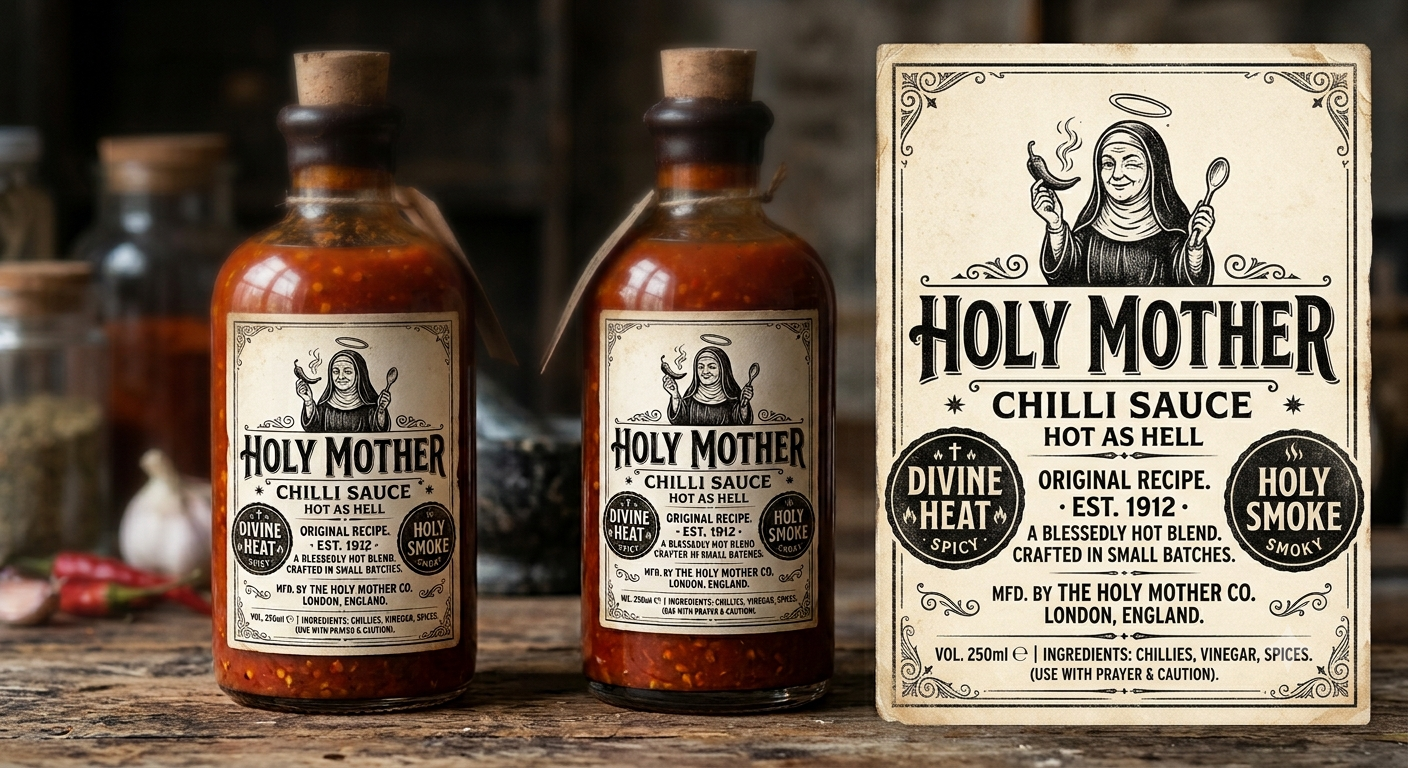
The batch on the first of April this year was called April Fool, and I ramped things up by prompting an AI label. It was fun to see the additional flourishes that AI added, perhaps not on the same level as faulty English signs in foreign countries, but in some cases surprisingly appropriate.
I decided to call yesterday’s batch Holy Mother, a case of an exclamation turning into a proper noun. This time I turned to Gemini, which also surprised me with some, uh, creativity. Not only did it design my label, it also spontaneously gave me this lovely pack shot.
One of the features of chillies is that pests leave them alone, probably for obvious reasons. Not so the feral tomatoes which sprout from time to time. These are so delicious that they attract the rats out of the adjoining forest (favela, indeed). I’m considering standing guard with an air rifle, because our three Weimaraners have proved to be utterly inept at seeing off these intruders. They are hunting dogs that haven’t lost the instinct but, surely, they can do one useful thing around the house other than snuggling up to people on the couch?
At this point I should be sharing a recipe for the chilli sauce, but the closest I can get is a method, which realistically is not that dissimilar to prompting an AI model. The outcome is somewhat variable, although representative of what one would expect of a chilli sauce.
I begin by cutting the stems off the chillies and slicing the biggest ones in half. Then I hot smoke them, using the leaves of our abundant Thai basil plant for fragrant smoke. This takes roughly 30 minutes. After the chillies have cooled down, I toss them into a blender with cider vinegar, some olive oil, garlic honey (and some of the garlic cloves that fermented in it), salt and pepper. For sweetness and breadth of flavour, I add roasted preserved red peppers that a chef friend made during lockdown. I still have a jar-and-a-half of this remaining, which will see me through to the end of 2027 after which a ‘recipe’ adjustment will be needed.
The pain factor is that I need to taste as I’m going along, to adjust seasoning as well as acidity. Bear in mind that one might mix a third or half a teaspoon into an entire bowl of pasta. Tasting it neat hurts. And it gets harder to be able to tune into what changes are necessary.
Kitchen time, whether baking the week’s bread, restocking the freezer with containers of braised mince, or making up batches of smoked chilli sauce, is about feeding into the future. It feeds me to perform this act of nurture for my family and our friends. My love language has a few dialects, and this is one of them.