
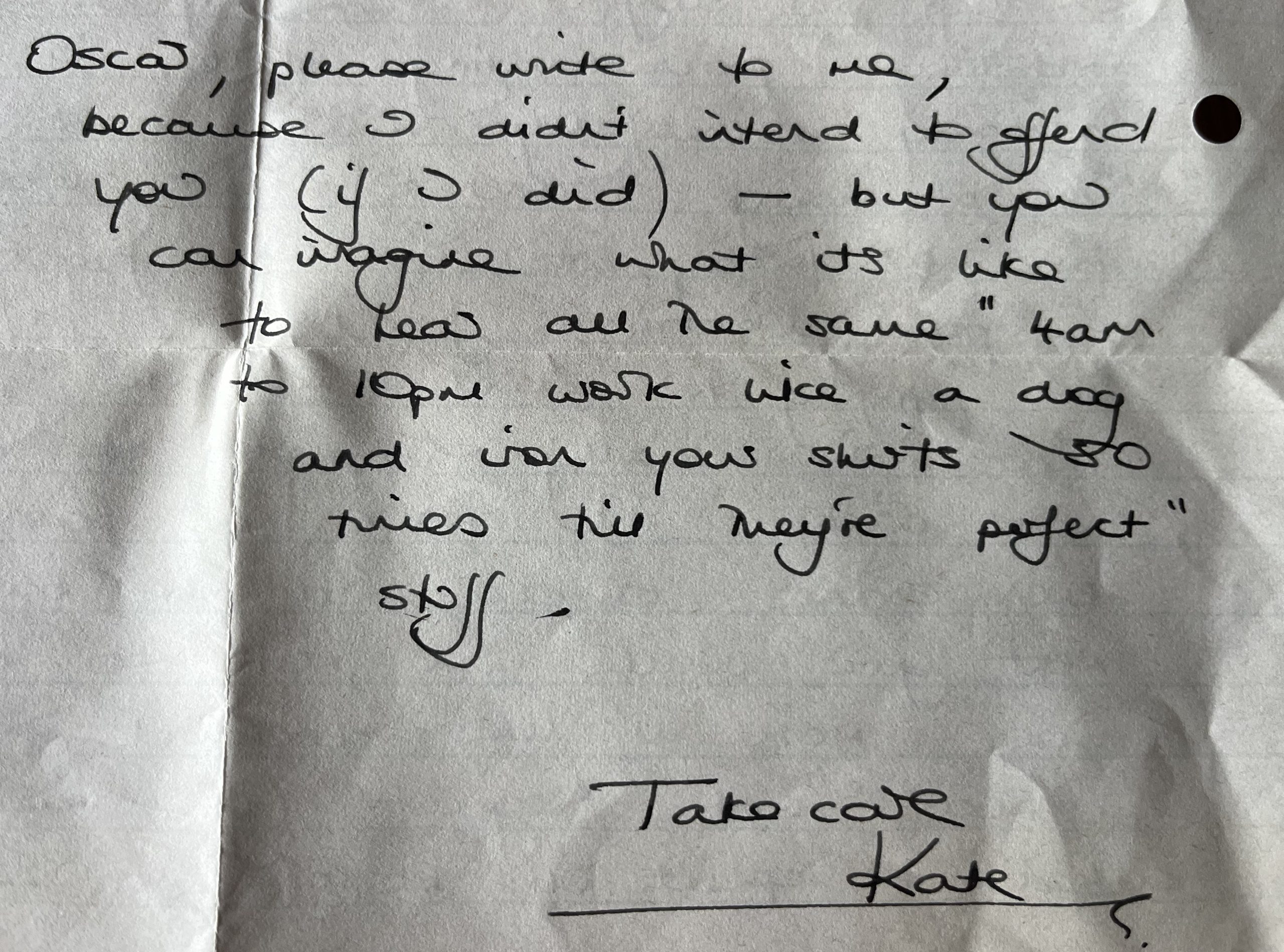
You are so right in calling out the absence of interest in my letters. I’m in the middle of a brand-new experience, surrounded by a bunch of guys I’ve never met before. I could be doing a much better job of corresponding with you. I may not have control over what happens every day, but I can choose how to respond. There is a bigger picture to us being trapped in this routine.
In my previous letters, I led with my exhaustion, rather than the spirit and camaraderie that mostly characterises our group. We are humans first, and that is something that they cannot take away from us, no matter how much they attempt to reduce us to a common denominator.
We have the easy side of national service, conscription, or whatever euphemism one applies to the Nationalist government having a force available to fight on its behalf, whether in townships, or beyond our borders. Our cohort comprises graduates, including numerous accountants and lawyers (and even a PhD), who will end up in desk jobs once their basic and officers’ training is complete. None of that real army stuff for us. We are sheltered from the horrors that others are experiencing.
Our off-duty conversations get interesting sometimes, with all this educated brainpower around, being deployed by bored idealistic youngsters for whom all of life is theory. When I got pink eye and was quarantined, I found a copy of Edward de Bono’s Lateral Thinking in the camp library, so mental stimulation comes from many sources.
As a bunch of thinking people, we have a complicated attitude to national service. We know we’re here because of the government’s suppression of a just revolution. We’ve arrived from university campuses where protests are a daily occurrence and then our instructors have added a layer of menace by attempting to indoctrinate us about the swartgevaar (black danger, the government’s scare-word for black majority rule).
And then, in the middle of it all, the government announced the unbanning of the ANC along with the imminent release of Nelson Mandela. Soon after, there was an announcement that our national service had been reduced from two years to 15 months (selfishly, this aspect was cheered by all of us). I was on a weekend pass when Mandela was released from prison and was able to watch it on television. I’m grateful that I could witness that moment in our country’s history.
For my final couple of years’ university study, I was also working full-time, and the work side of things got enormously stressful. So, this time away is an enforced break from all that. In a weird way, it’s like a holiday. I don’t know if I’ll ever again be in a position to switch off my brain to the same extent. Even the boot camp element is a positive; doing that much exercise is also good for the mind and spirit.
August’s pre-sunrise in Pretoria is cold, particularly for the guys from Durban. When we tree-aan (line up in platoon formation) in our brown overalls to be marched up to breakfast, they find it especially cold. Only once did we make the mistake of wearing jerseys (the rule is that if one person is wearing something, everyone has to match). The corporal made a big thing about us being cold and that he needed to warm us up on the way to breakfast. What followed was an opfok, or oppie (i.e. he fucked us up).
There’s a lot of hurry up and wait. Weirdly, it’s not so bad to disengage and just perform whatever mundane activity is required. Maybe this is part of the ‘holiday’ aspect. I think the permanent force (PF) sergeants and sergeant-majors take especial delight in making university graduates perform menial functions. You can spot the PF guys a mile off, with their slightly more faded uniforms and sharply ironed lines. They also have hoarse voices from shouting out marching instructions. Some have impressive moustaches.
Bungalow inspections are a daily thing. After we’ve made everything spick and span, everyone stands at attention at the foot of their bed, with trommel (trunk) open, blanket on top. The blanket must fill the trommel perfectly and the stripes on the blankets must line up all the way down the row. Everything else must line up – end of bed, the white fold of sheet showing, you name it. The bed must be made perfectly square (the trick is to make an ‘apple pie’ bed that has the sheet only going halfway before folding back up). Of course, the rectangle of sheet that is showing cannot have any creases.
All of us sleep on top of our beds, with pillow at the foot end, to keep the bed as pristine as possible between inspections. These can happen at all times of the day or night, and if the corporal is in a particularly bad mood, we might have to set up everything outside (in the same format as it would be inside the bungalow).
The bungalows have a red painted stoep that must shine. In the absence of polishing equipment, we spread wax and then polish it by pulling a folded blanket that has a trommel on top, with someone sitting on the trommel.
No part of our daily routine is the ideal way to deploy the energy and intelligence of young people, but we’ve taken the view that this is temporary and we may as well make the most of it.
We end every day exhausted, so sleeping under just a blanket the wrong way around on the bed doesn’t seem to be an issue. Weekends are the time for laundry and general relaxing. Wednesday afternoons are for Sport Parade (the same spelling in English and Afrikaans), and we have the opportunity of taking part in chosen sports around Voortrekkerhoogte. The guys have found a way back into the camp without having to go past the guards, so sometimes we go out afterwards, generally ending up in Jacqueline’s, Pretoria’s only nightclub. Angus has a car with him, an Alfa Romeo that makes the most wonderful sound when it revs, so we usually head out with him. To be honest, there have been times that I’ve ended up sleeping in the back of his car for the time that everyone is in Jacqueline’s.
The last part of officers’ course is Vasbyt, a multi-day test of endurance and resilience. One of the guys in my platoon, Hercules, nicknamed ‘Cules’ (with Afrikaans pronunciation), was struggling within the first few kilometres. It was my job to walk behind him and keep him going. I tried everything, but eventually all that worked was to insult him to the point of him stopping to take a swing at me and then the adrenaline would keep him going for a few minutes.
As you know, I’m not the strongest guy, but I just kept accumulating stuff to carry. For the last 20km I carried the radio plus multiple rifles balancing on my rucksack. A less pleasant load was the equivalent of three rat packs (plus additional chili con carne that others had discarded) in my bowel, which may explain some of my sense of urgency in getting to the finish.
We’d been warned about bilharzia in the streams. Whether from desperation to be clean, or as an act of rebellion, some of us swam anyway.
I think there is also a lot to be said for living a life that involves so much physical activity. Outside of professional athletes, few people exercise to the degree that we do every day. The Vasbyt hike was not my first experience of finding physical reserves beyond those I thought possible. Something similar happened to me when hiking in the Cederberg as a schoolboy. I don’t know where that strength comes from, maybe this stuff is more mental than physical.
I suppose part of the point I’m making in telling you about all this mundaneness is that we humans can live within a structure – and even find some pleasure in it – despite it deviating from what we would have chosen for ourselves. None of us would have wanted to live like this for years on end, but for the months we are, it kind of works. Maybe what’s necessary is that it’s been happening within the framework of a community.
A group of young men like this, slightly short of proper adulthood, is sometimes viewed as a tribe of its own, capable – or at risk of – actions that are particular to them. I don’t know if that’s true, but it’s interesting that societies have found it necessary to corral their young men into such situations. Or perhaps, at a more sinister level, leaders know that there are benefits to deploying young men to do their dirty work in the name of the greater good.
The stereotypical man in uniform is admired for discipline, fitness and aptitude. I wonder how many people would retain that view if they knew the extent of the dysfunction, incompetence and absence of motivation that has characterised our time in national service. We are not being prepared for a service of any kind of value, this is just us killing time as best we can.
At the end of Vasbyt, there was a braai for all the platoons. There was plenty of meat, but no grids for putting over the coals, so the guys carried out a few beds with lattice springs. That much brainpower would surely find a workaround!
So, several dozen guys were standing around when the commandant arrived. The protocol is that everyone must stand at attention as a mark of respect and thankfully someone quickly shouted “Aandag!” While we stood at attention, acutely aware of meat burning over the coals, but unable to do anything about it, he berated the poor planning that had required this but praised our ingenuity. Only then did he give the at ease command.
This is just a little example of the fucked-up institution of which we’re temporarily part; by design, subordination mindlessly orbits authority in a universe where bodies behind desks and ink on paper act as proxy for organisation and planning.
We’ve discovered a trick with the pay phone in the camp. If one does a half click of the phone rest, it returns the money that’s been fed and then you can make a call to wherever in the world, without charge, for as long as you want to. I suspect free calls is just one part of the attraction; we’re fighting back against the organ of State that has brought us here, by cheating the organ of State that provides telephony.
Please send me your number and I’ll call you (if I can ever get to the front of the queue for that wonderful phone!). I’m desperate for contact with the real world.
Take care,
Oscar
P.S. The language used by the South African Defence Force is Afrikaans (except for the sergeant who delights in saying, “comes to I”), which means that there are some wonderfully descriptive expressions:
Varkpan – pig pan, the rectangular nesting metal containers for eating meals
Vleisbom – meat bomb, unpleasantly descriptive for Parabats (the abbreviation for Parachute Battalion)
Rat pack – I’m guessing ‘rat’ is short for rations, but the rodent angle is apt
Balsak – ball bag, the large duffel bag into which one packs a complete set of kit and uniform
Staaldak – steel roof, the helmet that is part of our uniform
Bak bal – bake balls, the act of lazily lounging in the sun while awaiting the next instruction
Go cart – there is a low-slung seat that goes on top of pit latrines dug in the bush, for which one assumes a go kart position
Pislelie – piss lily, the extended funnel with buried end for use as field urinal
Soutpiel (or soutie) – salt penis, referring to English speaking South Africans, one leg in Britain and the other in South Africa with penis dangling in the ocean. Pejorative.