
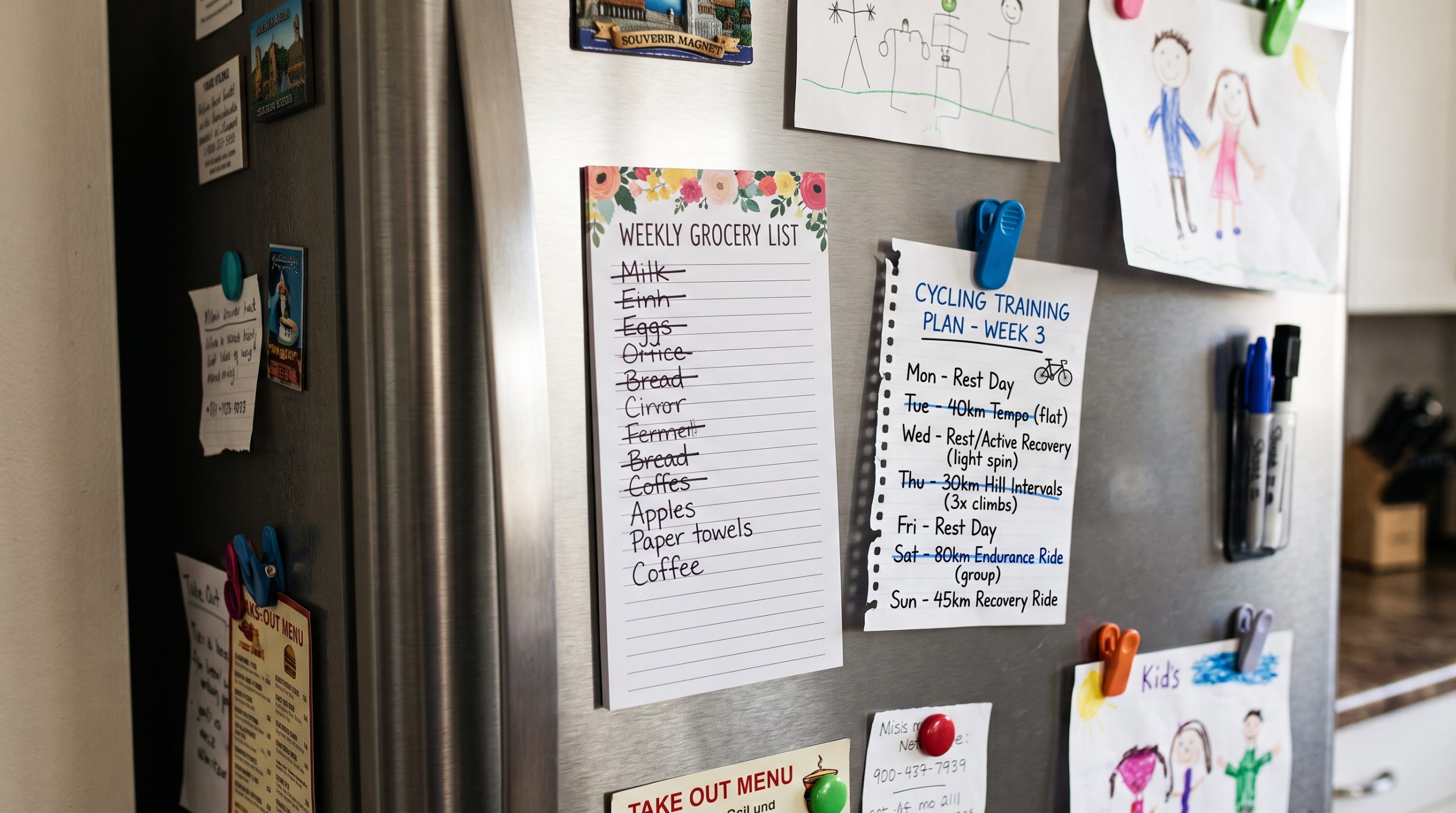
Origin stories are often rooted in a general set of circumstances, or a vague timeframe. On the other hand, the sole aphorism for which I can claim credit is one that I can tie back specifically to an A4 sheet of paper that lived on our fridge door for six weeks. It was a simple listing of dates and times, in this case, my 33 sessions of radiotherapy between the end of January and early March 2016.
After each session, I crossed off its listing, as I counted down to the completion of the treatment. When I was well enough to start exercising again, this schedule was replaced with a training programme that would get me to the start line of the Absa Cape Epic almost exactly 12 months after finishing treatment. Whatever the programme told me to do on a day, I did it. And then I crossed it off the list. The following two Cape Epics also involved training programmes that I followed without question, except that I didn’t print them.
Hence me adopting the phrase, “You can’t negotiate with a piece of paper.”
After 2019, I no longer had training programmes, but I continued to cycle regularly, mostly four times per week, but never less than three. Participating in multi-day endurance events became less interesting, so I didn’t need that level of fitness. I followed a consistent pattern to my riding, but the decision about what to do on any given day became fluid, because the negotiation was with myself.
I wrote Floyd Plunkett’s Diary as an exercise in looking at a man’s relationship with his chosen AI, and how this might impact on his life. Throughout the writing process I was mirroring Floyd’s path by testing his prompts or enquiries on a panel of AI platforms. The story went in a direction that I didn’t anticipate, which is entirely a reflection of the creative process.
AI could not have written the story, but I remain curious about uses of AI as a tool.
Last week, I noticed a message on Strava that my account could be linked to Claude. Ever the explorer, I did just that, and invited Claude to dig into the data. My inner nerd was fascinated at Claude’s insights based on my cycling over the past few years, with granularity extended to multi-year comparisons of heart rate and speed over a variety of segments. Claude even offered to do second-by-second analysis of high intensity intervals.
This has taken me along a new path of AI discovery. The first outcome is that I have re-committed to sessions of Norwegian 4x4s every Thursday, which I used to do, until I got out of the habit. These high intensity intervals are most effectively done in conjunction with easier recovery rides. Paradoxically, these also require discipline, because the athlete has to hold back at a level of exertion that feels too easy.
Claude entered the equation by suggesting a training plan. My eagerness to check on the data once the ride has been uploaded also makes Claude my virtual ride buddy, in motivating me to cross that next item off the list. It’s a useful tool in supporting my self-discipline.
If you’re already thinking about AI’s people-pleasing nature, you might imagine me telling Claude that my legs feel too heavy for a 4×4 session, and Claude obligingly letting me off the hook. However, Claude is going to keep putting 4x4s on the programme, supported with data that demonstrates how my fitness is going to benefit. It remains my choice, with Claude and Strava each occupying a shoulder as voices of conscience.
Claude hasn’t yet used the terminology “coffee ride” for one that involves low intensity. For these, Claude can never replace the friendships that have been built over the course of many dozens of hours of riding together. Similarly, I wouldn’t have trusted Claude to get me from the ashes of radiotherapy to Cape Epic. However, I can see Claude’s virtual paper doing a pretty good job of helping to move my baseline fitness closer to where I was seven years ago.