
Reputation has a way of attracting opportunities. When it came to wine in the early 90s, I was known as the guy who shifted bottled wine that couldn’t be sold through producers’ regular channels. My method was to apply a sticker with the minimum information required and to sell it in my warehouse outlet at a knockdown price, which was a step up from the garage from which I’d started by (illegally) selling off a cancelled export order.
A year into legal operation, I was 27 years old, without any sense of how dangerously little I knew. Worse, I was decades away from learning to temper ignorance with humility. So, I felt very important when a representative of the KWV, then the most serious and most important of wine industry organisations, offered me a bargain-priced parcel of Méthode Cap Classique (MCC, the South African designation for sparkling wine made in the Champagne method) . Of course, there was a catch, in that the wine was still under crown cap, having completed its second fermentation in bottle. Technically, they shouldn’t have been selling to someone with a retail licence, so this was flattery on flattery. They were clearly keen to do business with me.
I worked out that I could get this parcel onto the market at half the price of the major sparkling wine brands, so I was very keen to do this deal.
I was still exploring ways of completing the production process when I was offered three vintages of MCC by Blaauwklippen, also under crown cap at the same price. This took the total number of bottles to 100 000, which at that time was 10% of South Africa’s annual sales of MCC. There were all kinds of ways of approaching this in a sensible way, but I ignored them all.
Assuming I had the cash to fund the project, which I didn’t, the Blaauwklippen tranche (80% of the total) still needed to be riddled (i.e. taken through the multiple rotations that would take the bottles from horizontal to vertical, with the spent yeast collected in the neck of the bottle). After this, the entire batch needed to be disgorged, dosage added, then corked and labelled. It’s all very technical, with specialist equipment required, not to mention a facility in which all this would be done. Oh, all of this takes time, which was a problem because I needed the bottles ready for Christmas sales.
I kept getting little flashes of hope, with possible funders expressing interest. On the production side, I couldn’t find a cellar to do this for me. However, I could get a short-term rental on a warehouse in the same complex as my outlet and Blaauwklippen had most of the equipment I needed. I could rent a forklift. I could also rent a refrigerated container, which was necessary to chill the bottles prior to disgorging.
With this Heath Robinson plan taking shape, it all remained very stressful, and even though I had a confirmed supermarket order, I still didn’t have the funding confirmed. After lying awake for an entire night, I decided to throw in the towel. As ‘luck’ would have it, soon after getting to work that morning I had a call back from a funder to confirm their investment. With this in place, I made my final commitments.
And then the funder backed out. I was back to square one, but eventually two friends drew money out of their mortgages to invest.
This all happened more than 30 years ago, so I don’t have detailed records, but I think we finally started the production process something like six weeks before Christmas. It was at this point that we discovered that the bath for freezing the necks of the bottles didn’t work. We would have to do the disgorging à la volée (on the fly). Practically, what this involved was watching the bubble move from the base of the bottle, up past the shoulder, and to time the removal of the crown cap to the moment just before the bubble dislodged the yeast. Do it too early and you lose too much wine, do it too late and you lose the whole bottle due to the yeast making it cloudy by mixing into the wine.
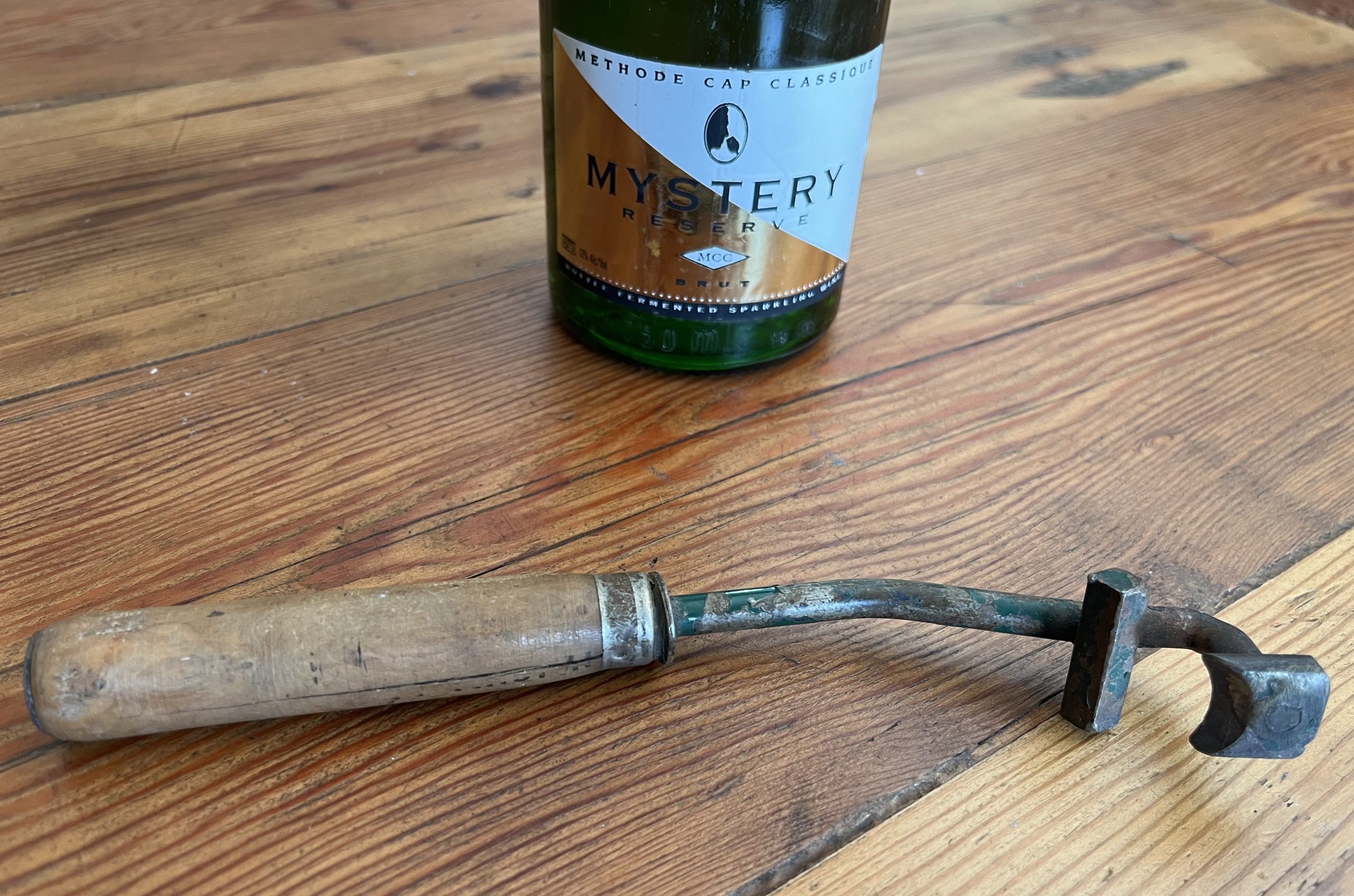
The tool pictured above, clé à dégorger (disgorging key) is what we used to remove the crown cap. There were three of us on that part of the production line, me, Stuart Downes and Garron Elmes, so each of us would have disgorged at least 30000-odd bottles.
The rest of the team comprised people we literally picked off the street. Considering that Cape Town’s most notorious drug market, Gympie Street, was just across the road, you can imagine how many prison tattoos were on display. I don’t think any of them had all their teeth. We worked 24 hours a day, seven days a week, to get the job done, and the radio was at full blast throughout. In typical Cape Town factory fashion, workers danced their way through their shifts.
No-one got a knife wound, but we did have a few bottles explode in workers’ hands during our very rough and ready riddling process. Banish any romantic thoughts of pupitres (riddling racks) in dimly lit caves, or gyropallets gently shaking the yeast down to the bottles’ necks. We were out of time and options, so we simply gave the bottles a good shake and popped them top down into crates. The least of our problems was that there was one vintage with yeast that got stuck to the side of the bottles. More serious was the vintage with faulty bottles, which had glass of irregular thickness. The warehouse in which were working was over 30 degrees; probably the most unsafe way to handle hazardous bottles pressurized to six atmospheres, hence the explosions. It could all have got very messy.
This was not our only production challenge. We couldn’t set the corker accurately. So, if the cork went it far enough for the muselet (wire cage) to fit, the cork was very hard to remove when the customer wanted to open the bottle. All labelling was done by hand, with a remarkable degree of precision. Theoretically, we mimicked each step that happens in Champagne production, but in the most unprofessional way possible.
The unlabelled bottles I sold in the warehouse were referred to as mystery wines, which eventually turned into an actual label, with Mystery becoming a brand. In the case of this MCC, mystery had additional meanings. Our loyal and long-suffering customers had no idea whether a bottle would explode in their home, whether the contents may be cloudy, or whether they’d have to resort to a corkscrew to get the cork out of the bottle.
Fortunately, no corkscrews were required for the batch served at our wedding, two weeks later. As we said, “I do”, we could hear corks of our own bubbly popping in the background.
I don’t expect to ever again need to use a disgorging tool, but I’ve kept it as a reminder of a project that was crazy – and amazing – in so many wonderful ways.