some image

Having fun, writing about the stuff I like

Where’s the Glory?

Oscar Foulkes March 29, 2011 Books No comments

Jon Krakauer’s book Where Men Win Glory is one of the most thought-provoking I’ve read. On one level, it’s the story of professional footballer Pat Tillman’s life, ending at the hands of ‘friendly’ fire that the US Army did its best to obfuscate. It’s a heartbreaking story, made more tragic by the knowledge that dozens of soldiers (in the broader sense encompassing the navy and air force) die under similar circumstances every year.

Military Intelligence is often used as an example to describe the word ‘oxymoron’. To this, having read Krakauer’s meticulously reported book, I have to add “military precision”. The story of Jessica Lynch’s rescue from an Iraqi hospital was widely spun by the US government at the time. The part that was missing from the tale was the blundering that led to her capture, as well as the unnecessary death of numerous military personnel (some of them as a result of fratricide) that accompanied the sad episode.

Bruce Springsteen sang, “War, what is it good for?” To this one has to add a whole bunch of questions about the motivation of ordinary people who sign up for hardship and possible death. Through the example of Pat Tillman we see that it obviously is not money. Rousing rhetoric invoking patriotism seems to be quite effective. In fact, doubly so, because any dissenting views can be trashed as “unpatriotic”.

The rescue of Private Lynch and the death of a football star while in the service of his country are – furthermore – fabulous material if you’re wanting to manipulate a gullible populace into supporting a war effort. Krakauer quotes Hermann Göring:

“Naturally, the common people don’t want war … Voice or no voice, the people can always be brought to the bidding of the leaders. That is easy. All you have to do is tell them they are being attacked and denounce the pacifists for lack of patriotism and exposing the country to greater danger. It works the same way in any country.”

The way that many industries work has changed profoundly as a result of the internet and other technology. Yes, modern weapons are much more high-tech than they were 50 years ago, but the fact remains that soldiers, seamen and airmen (and women, in each case) can still expect to be killed, sometimes by their own side. The main differences between war in the 21st century, compared with the 11th century, is that death is inflicted at greater distance and is more likely to involve fratricide. It remains a brutal and crude solution to the problems of animals capable of reason.

Perhaps I’m an idealist; I can just can’t seem to get rid of the feeling that war is an anachronism. Surely there’s a better way of resolving conflicts?

“Yes, an’ how many times must the cannon balls fly
Before they’re forever banned?”

(Bob Dylan)

No-Moo Monday

Oscar Foulkes March 28, 2011 Uncategorized No comments

While our family quite often has vegetarian meals, these probably don’t occur on a weekly basis, and certainly not on a fixed day of the week. So, this evening we had our first-ever Meat-free Monday.

I made a curry, with chickpeas and roast butternut, and it really was a hassle-free experience. The first step was to make the curry base (if you’re not in the mood for all this, simply buy one ready-made here).

Making the Curry Base
I fried two chopped onions, and then added two cloves of chopped garlic with about two inches of ginger (grated). Once the onions were translucent I added the spices:
2 heaped teaspoons of NoMU Indian Rub
5 heaped teaspoons of NoMU Masala Rub
I also put in about 100g of flaked almonds, which added flavour and gave a nice texture to the finished result.
After a minute, or so, of roasting in the pot I added the liquid:
1 small tin (400g) of chopped tomato
1 small tin (same size) of coconut milk
This whole lot was left to simmer covered for an hour, after which I added NoMU Vegetable Fond (concentrated liquid stock) to taste, as well as salt and about a cup of water.

Assembly
A couple of minutes before service I added two 400g tins of chickpeas (drained), as well as the pre-roasted chunks of butternut, to warm through.

The curry was served with Basmati rice and steamed broccoli. I washed it down with Cloof’s The Very Vivacious Viognier, which was a very happy companion to the spicy (but not ‘hot’) food.

Curry is one of those meals that often features as a takeaway meal, largely – I suspect – because we’re too intimidated to make it ourselves. Our curry this evening was every bit as successful as anything we’ve bought it. And, four of us ate ourselves into a stupor for a fraction of the cost of a lamb roast.

Thank God, though, Meat-free Monday only comes around once a week. As delicious as this evening’s meal was, a perfectly grilled pork chop is so much more satisfying.

(Disclosure: my sister, Tracy, and her husband, Paul, founded, own and manage NoMU. The name arose from Tracy’s interest years ago in opening a vegetarian deli, which would sell no meat, or No Moo, hence the name. NoMU’s online shop is one of my web projects.)

Sport in Cyberspace. Champagne in Real Life.

Oscar Foulkes March 16, 2011 Wines No comments

We’ve all had “you had to be there” moments, when we’ve been recounting a humorous experience, which in the retelling is not as funny as it was first time around. In fact, it may not even be the slightest bit amusing, in which case one is desperately looking for the nearest carpet to hide beneath.

We also have experiences that link us to momentous events in world history. For instance, at the time that I heard of the planes flying into the Twin Towers I was sealing off several dozen duck breasts.

And, at the time that that heroic man Robin Peterson was smashing the winning runs in South Africa’s group stage match against India, I was tasting – actually, drinking – the 1959 Champagne Guy Charbaut Cuvée de Reserve, an experience of such rarity that I should perhaps have phrased it the other way around (i.e. what was happening elsewhere in the world as I was drinking this venerable wine). The occasion was a function organised by the Cape Town branch of the International Wine & Food Society (IWFS), held at sparkling wine producer Chabivin in Stellenbosch.

I was watching the ball-by-ball commentary on the Cricinfo app I had downloaded onto my iPhone. Trust me, the tension was not diminished in any way by not being either at the game, or watching it live on television. During that epic run chase there were good overs and bad overs, not to mention wickets falling at inopportune times. But, as the number of balls remaining grew smaller the required target loomed larger. The remaining batsmen were facing perhaps the greatest challenge of their sporting lives. History was waiting to be written.

If ever there was an excuse for adopting the ‘chokers’ mantle, this was it. The situation called for calm heads and sure blows. Preferably ones that despatched the ball comfortably over the boundary ropes. De Villiers, Duminy, Du Plessis and Botha all contributed handsomely. With 12 balls remaining, 17 runs were required. Do-able.

But then the sheer numbers of cricket fans overwhelmed the Cricinfo servers. The ball-by-ball updates stopped. No, they were choked!

I was desperately refreshing the screen, while Jean-Pierre (married to the founder’s granddaughter Brigitte) was speaking passionately about his product. The significance of 1959 was that Brigitte’s parents married in that year, we were told.

Then, a partial update at the end of the penultimate over: 13 runs required. Where was that ball-by-ball? I was getting desperate, but the ’59 wasn’t lost on me. Its gorgeous caramel and mocha flavours were the product of over 50 years in bottle. The mousse, while not vigorous, was present.

Another partial update. Four balls remaining, three runs required. By application of simple mathematics it was obvious that the first two balls of the over had resulted in a four and a six, but that blessed ball-by-ball was still absent – thankfully the only choking being done was by Cricinfo.

Refresh. Refresh. The tension had by now, definitely, got the better of me. Then my phone rang, ‘Home’ was identified. I hastily rejected the call (it’s one thing to follow an iPhone app during a sit-down presented tasting; it’s another thing altogether to speak on it). Then the damn thing rang again, ‘Mom Cell’ was identified. Reject.

Those calls in quick succession told me the result. Would I have felt any differently about it had I seen the two runs that levelled the scores, and then the four that secured victory? I don’t know, but I would have loved to have been at home to experience my son on our balcony, as he blew his vuvuzela for two minutes in celebration.

Champagne is the drink of celebration, and by this point I was virtually bathing in the stuff, so I wasn’t exactly getting by-passed in the celebrations.

Dinner followed. Outside, we were seated at one long table as we ate a delicious meal prepared by the IWFS food committee (you can read about a previous IWFS function I attended here).

It was a fabulous evening. You really should have been there.

Chabivin is a joint venture between Champagne Guy Charbaut and South African winemaker Hendrik Snyman, which is making small quantities of Methode Cap Classique (champagne-method sparkling wine). We first tasted 2011 base wine (no bubbles yet), and then 2010, which had been on the lees for eight months (Hendrik is a man of many talents – he also took the pictures above).

After this we were treated to a recently disgorged 1999 Blanc de Blancs from Guy Charbaut, which was very fresh (bottle age occurs most rapidly when Champagne is on the cork) and quite delicious. The tasting continued with the crowd-pleasing non-vintage Guy Charbaut Selection Brut, and included two further vintage Champagnes, the 2000 Guy Charbaut Millesime and 1998 Guy Charbaut Memory.

Robbin’ the ‘hood

Oscar Foulkes March 14, 2011 Uncategorized No comments

More gangsta than police boss (in dress, certainly), Bheki Cele

Three weeks have now passed since the Public Protector, Thuli Madonsela, released her report, in which she found National Police Commissioner Bheki Cele guilty of improper conduct and maladministration. There are no signs of Cele facing any disciplinary procedures, and the R500 million lease that was the subject of the investigation remains in place.

The bare bones of what went down is that Cele’s mate, Roux Shabangu, bought a R50 million property once he had the assurance that SAPS would enter into a R500 million rental agreement. Sweet deal.

If the guy who heads the police service can act without probity – with impunity – it is time for us to be asking Quis custodiet ipsos custodes (who will guard the guards themselves)?

Last night’s Carte Blanche highlighted the appalling state of schools in the Eastern Cape. At best, it’s a product of inept administration and negligence. At worst, well, you can toss in every variation of fraud, theft or corruption that pops into your head.

Apart from the loss of taxpayers’ funds, the people most affected by this knavery are the kids being deprived of an education (not to mention the lunch they’re supposed to get while at school).

I’m not suggesting that Robin Hood lived his life by exemplary morals, but he occupies a place of some respect, if only in legend, in that he relieved only the rich of excess belongings. The robbing being done in South Africa is from neighbourhoods who can least afford it. And the robbing isn’t of surplus material objects; communities are being deprived of safe water, sewerage, education, housing and basic health care. Yes, some of these shortages are the result of insufficient resources, but how much more could be done if government (at national and local levels) was both honest and efficient.

Zuma and his cronies should be aware that the demographics in South Africa (large numbers of unemployed people under the age of 30) are very similar to Tunisia, Egypt and Libya.

The upcoming local government elections could get very interesting indeed. I’m not expecting a huge shift in voters to parties other than the ANC; the number to watch is the percentage turnout. A low voter turnout in traditional ANC areas will be tantamount to a vote of no confidence.

A Different View of ‘Choking’

Oscar Foulkes March 8, 2011 Uncategorized No comments

I grew up with my mother using the words “England expects” as preamble to any important assignment I had, whether it was sporting or academic. It wasn’t that our family has any fealty to England; more that it seemed appropriate to borrow from Admiral Nelson’s “England expects that every man will do his duty”, which was the message that went out to his fleet just prior to the Battle of Trafalgar.

The expectations of a nation are a heavy mantle; especially when either of the Proteas or Springboks (South Africa’s national cricket and rugby teams) take to the field. Sunday’s group stage match in the Cricket World Cup, against England, was no different.

Except, every time the Proteas lose an important match they would have won most other days they are accused of having ‘choked’.

Scoring at three runs to the over, even on a dodgy pitch, is not a tough ask of a team that has aspirations to winning the entire tournament. But, to the disappointment of millions of South Africans, they were bowled out seven runs short of the target, with plenty of balls to spare. Two fours would have done it; a six would have resulted in a tied result. But no, in the final analysis, the team was devoid of the heroics that would have brought victory and honour to the team. How many times have we not seen – in a one-day international – victory being snatched from the jaws of defeat by a single batsman standing tall, smashing the ball to all corners of the stadium?

It is very easy to sit at home, watching the ball spinning harmlessly through the air in slow motion, and suggest that the men did not do their duty. That they choked when confronted with the hugeness of the task at hand.

On the other hand, a group of men (and women) who certainly didn’t choke on Sunday – either literally or figuratively – gathered for a late afternoon lunch at our house. They were predominantly chefs, their spouses and kids, as well as a few foodie-inclined people. The centre-piece of the lunch was slow-roasted shoulder of pork (two of them, to be precise), weighing in at 13kg. It was way too much food, but we knew that only one shoulder would be too little.

In cricketing terms, it was a bit like being asked to score 100 overs’ worth of runs in only 50 overs, but the guests went about their eating with such gusto that the leftovers were quite minimal. No-one could accuse them of having ‘choked’!

As an experiment, we cooked the two shoulders slightly differently. Each of them was rubbed with a mixture of fennel seeds and salt, and laid atop a bed of chopped onion, carrot, garlic and fennel bulbs, moistened with a bottle of white wine. They were roasted for about eight hours at 100-degrees. One of them, though, was covered with foil, which trapped the moisture. Just before service we added half a litre of chicken stock to each roasting tray and cranked up the grill to crisp the now-uncovered covered one.

The crackling on the one that had been roasted uncovered may have had the slight edge, but the meat of the covered one was juicier and more tender.

I took a little straw poll amongst the chefs, and we agreed that the best way to get perfect crackling is to remove the skin from the roast, slice it thinly, season it well, and then whack it under the grill. Getting the perfect roast, as well as the perfect crackling, is a lot easier when the processes are separated.

Cricket, of course, is a symbol for gentlemanly behaviour, in which the principles of sportsmanship are theoretically sacrosanct, hence the expression: “It’s just not cricket.” Losing with grace implies that one praises the excellent performance of the winners. To say that South Africa choked yesterday against England is to give insufficient credit to a few excellent balls bowled by the likes of Broad, Anderson and Swann.

The literal meaning of ‘choke’ is to restrict the flow of something. In this case, the flow of runs was constrained by a combination of good bowling and tricky pitch. The Proteas’ batting certainly wasn’t up to par, but was it the product of a psychological problem running through the team? I don’t think so. Golf is perhaps the most ‘psychology-driven’ of all sports, and even the best golfer in the world doesn’t win every tournament he enters.

Saturday’s game against India is a shot at redemption, and I’m pretty sure the Proteas are going to be pumped up for it. South Africa expects.

iPhone Pics

Oscar Foulkes March 3, 2011 Uncategorized No comments

I took these pictures just before 7.00 am on Wednesday. The day before had been hellishly hot; when I walked out of the front door at 6.00 am I could feel the wonderful chill of the fog off the Atlantic Ocean.

Looking north, towards Blouberg

Our usual Wednesday morning ride takes us to the King’s Blockhouse, on the slopes of Devil’s Peak. The views were spectacular, and thanks to my iPhone 4 I was able to record them!

The City Bowl, with Lion's Head to the right

I have been known to projectile off the front end of the bike, so maybe these sleek bits of metal have something in common, after all!

The Power of Pass-it-on

Oscar Foulkes March 1, 2011 Books No comments

It is a requirement of people who live an online life – especially those who do it professionally – to be at the cutting edge of whatever is new. In doing my own little bit of ‘pass-it-on’, about a wonderful book I’ve just finished reading, I am revealing myself to be a long way behind the times. You see, Viral Loop was published in 2009, and 15 months, or thereabouts, is a very long time in ‘online years’.
It was only as I reached the end of the book that I realised its author, Adam L. Penenberg, writes for Fast Company, one of my favourite reads of the month. What he’s done in this book is to take the internet hall of fame – Hotmail, Flickr, Google, Paypal, eBay, Facebook and others – and use them to illustrate the power of virality. Even if tech and internet aren’t your things, it’s fascinating to read how these turned into huge and successful companies.

What one doesn’t realise is that other people were doing similar things at the same time. The ones that made it hardwired the viral loop into their offering, which is what ultimately allowed them to gain traction.

The opening chapter deals with Hot or Not, a website which illustrates the effects of virality perfectly. Within 90 minutes of launch, the number of users doubled every two hours. On the second day, they doubled every hour. Penenberg tells the story of how the site’s founders, James Hong and Jim Young, scrambled to find hosting to keep the site up during this eye-popping growth. It reads like a thriller.

It isn’t all internet, though. Tupperware gets a chapter, too, and serves also to illustrate the need for product creators or brand owners to communicate the relevance of products if they want to sell them successfully. It now seems self-evident that no household can survive without Tupperware, but before Brownie Wise got her teeth into the brand it languished on shop shelves. The sales method she created has been copied by myriad other businesses, becoming a cliché in the process.

If you only read one business-related book this year, make it Viral Loop.

Wine Whine

Oscar Foulkes February 28, 2011 Uncategorized No comments

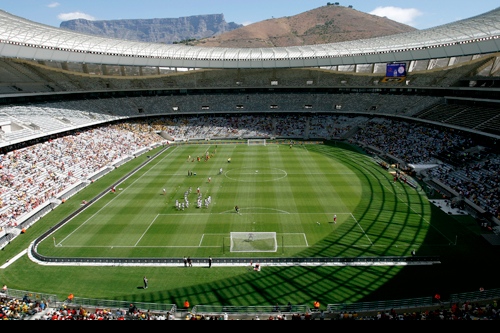
During the fabulous U2 concert, at the fabulous Cape Town Stadium, I needed to buy drinks for our group.

Four of us wanted beer. No problem there, other than the somewhat pricey R20 for Heineken. However, I also needed to buy one white wine and one red.

I can understand the principle of brands paying for the rights to certain concessions, hence Heineken being the only beer on sale.

However, for a city within such close proximity to the Cape’s winelands, it seems completely unbelievable that its biggest taxpayer-funded facility would not have wine for sale. The wine industry, of course, is one of the biggest contributors to the Western Cape economy, employing some 275 000 people.

The argument that Heineken paid for the concession rights doesn’t hold. Imagine if some other principality paid for the rights to display the backdrop of another land feature, so that visitors to Cape Town Stadium saw not Table Mountain, but Mont Blanc or the Sugarloaf.

The stadium is going to be funded by taxpayers for decades to come. Is it too much to ask that the benefits are holistically extended throughout the Western Cape economy?

Looking at this from another angle, distribution/availability of product is one of the wine industry’s biggest obstacles to building market share. This largely has its roots in the fact that no single brand has sufficient budget to buy its way into the market, the way that brands like Heineken can. Collectively, the entire world’s industry could, but one cannot imagine them co-operating to that extent.

Until then, Capetonians will pay a premium to drink Dutch beer in their own stadium.

Kakonomics

Oscar Foulkes February 22, 2011 Uncategorized No comments

Gloria Origgi: "Kakonomic worlds are worlds in which people not only live with each other's laxness, but expect it: I trust you not to keep your promises in full because I want to be free not to keep mine and not to feel bad about it. What makes it an interesting and weird case is that, in all kakonomic exchanges, the two parties seem to have a double deal: an official pact in which both declare their intention to exchange at a High-quality level, and a tacit accord whereby discounts are not only allowed but expected. It becomes a form of tacit mutual connivance. Thus, nobody is free-riding: Kakonomics is regulated by a tacit social norm of discount on quality, a mutual acceptance for a mediocre outcome that satisfies both parties, as long as they go on saying publicly that the exchange is in fact at a High-quality level."

There was a time when ‘bugger’ was a very rude word. While it seems to be an acceptable expletive these days, I’ve never been able to work out how one could also use it to refer to someone (i.e. in a ‘bloke’ or ‘fellow’ type of context), when one of the senses of the word is what the blokes are allegedly doing to each other. Oh well, such is the evolution of language.

Closer to home we have our own beloved kak, which can be a verb, a noun, or an adjective. It is furthermore used as an expletive and as interjection. The word is most likely derived from the Dutch kakken (i.e. shit), but it more generally is used to denote that something sucks (interestingly, the vowel sounds in the middle of kak and ‘sucks’ are the same).

I was amazed to discover last week that academic papers have been written about kakonomics. The South African in me was quick to jump onto the prefix, and without any further study I assumed that I had a grasp of what the content was likely to be, especially when combined with yet another beautiful South Africanism for which there is no adequate translation: gatvol.

The literal translation – full hole – doesn’t come close to conveying the particularly ‘fed-up’, ‘had-enough’ state of irritation/frustration implied by gatvol. I assumed that gatvol had a role to play in kakonomics.

Of course, even the word kakken had to come from somewhere. Many European languages have their own versions (think caca), and they all refer to the same smelly stuff. The person behind kakonomics – Gloria Origgi – is a published academic in English, French and Italian, so she presumably has a bird’s eye view on the language side of things.

So, what is kakonomics? To use Origgi’s definition, it’s “the strange preference for low quality outcomes”. In other words, a tacit expectation of mediocrity from the person on the other side of the transaction enables one’s own mediocrity, and hence reduced feelings of guilt.

I think there’s plenty of that all around the world, but a particularly gatvol South African could pin-point dozens of instances every day where compromised exchanges take place.

Basically, it all comes back to buggery. You know that you are kind of going to get screwed by having to accept a lower standard than what you may have professed to expect, but you are going to screw the half-deliverer back by reneging on part of your promise.

And, because no-one feels any guilt it all has a happy ending. That’s kakonomics.

One Man’s Gnocchi

Oscar Foulkes February 21, 2011 Restaurants No comments

Eleven years ago I attended an intimate performance of Via Dolorosa by John Maytham at Pieter Toerien’s Theatre on the Bay. Nothing I’ve read, nor anything I’ve watched on TV, has done a better job of explaining the Israel-Palestine conflict to me. John was brilliant, as he always is when he puts his radio mic aside once every couple of years to address the world’s great issues in one or other theatre production.

Pieter Toerien – operating without any subsidy or public funds of any kind – has a record of more than 40 years in theatre, which is remarkable. Without any disrespect to John’s Via Dolorosa, he’s been successful because of a keen sense of what shows will put bums in seats. Generally, that involves a whole lot of feel-good, and not too much challenge.

Since early-November, Dish has been operating the restaurant at Theatre on the Bay (I wrote about the wine list here). Apart from any other consideration, the main issue we’ve encountered is the limited time to serve pre-theatre dinner, especially when guests arrive at 7.35 and expect to be served two courses before 7.55 (we advise arrival by 7.00).

By way of a little marketing we invited a selection of theatre and food writers/bloggers last week. I was at home, but as I follow a few of them on Twitter, I made sure to watch the Twitter stream, and was heartened to see the first positive comments from @SamWilson1. Then @RelaxWithDax weighed in with rave about the gnocchi. Sam immediately countered with a comment about order envy. It was like watching the big game on TV, but scary too, because I knew before the chef did whether they enjoyed their meal, or not. As did the thousands of people who follow these tweeters.

On the night there were other raves about the gnocchi, which is served with a little truffle oil, an almond cream, mushrooms, green beans and confit beetroot. I think it’s a great dish.

However, it’s had more send-backs than we’ve had for any other dish on the menu, which I think is a product of the way the gnocchi is cooked. You see, after it’s been blanched we sauté the gnocchi in a pan to give the outsides that lovely golden caramelised finish which is so tasty. It’s admittedly not the mainstream way of serving gnocchi, but it’s certainly out there, and a lot more flavourful than boiled dumplings swimming in a bowl of sauce.

When we had gnocchi – also sautéed – on the menu at Vaudeville we had similar issues. I therefore think it’s time to take a leaf out of Pieter Toerien’s book; future Theatre Bistro menus will attempt to be the culinary equivalent of Andrew Lloyd Webber’s musicals or Defending the Caveman. Sadly, there isn’t room for gnocchi from ‘the fringe’. Having said all the above, the possibility remains that the kitchen messed up, delivering a sub-standard meal, in which case the plates had every right to go flying back to the kitchen.

Of course, how one likes one’s gnocchi is subjective. And, regardless of which side one finds oneself, neither side is right or wrong. So, we’ll accept this as a high-risk zone (also from the perspective of the kitchen producing perfectly fluffy ‘pillows’ of gnocchi) and move onto something else without getting unnecessarily emotional.

One area that does have an empirical basis, however, is the measurement of a glass of wine, which is stated in the wine list as 150ml. I come at this from a wine perspective, so we insist on using proper crystal glasses, which have a bowl size of over 400ml. No amount of explanation, nor measuring devices, can divert guests from their firmly-held view that we’re giving them less wine than they paid for (the glass isn’t full, after all).

At some point in the evening, however, the guests need to go back downstairs, which is when they find themselves wondering why they are not negotiating the stairs so well after two “small” glasses of wine (300ml, after all, is not that far away from half a bottle).

The problem is very easily solved, of course. All we need to do is change to those horrible little clunky glasses that do wine such a disservice and fill them to the brim. What’s standing in the way is principle; that Sidedish Theatre Bistro will not deviate from serving wine in proper glassware.

Which raises the question: if something as trivial as glassware can make someone this intractable, how can there ever be reconciliation between Israel and its Arab neighbours?

Click here for the March 2011 menu.