some image

Having fun, writing about the stuff I like

An Open Letter to the MyGate MD

Oscar Foulkes June 15, 2011 Web Tools 17 comments

Dear Dan

I hope you don’t mind me calling you Dan. I know that’s your name because I asked your employees the name of MyGate’s managing director. I left several messages for you to call me, but perhaps your telephone lines are down, the way that your computers so often seem to be. By the way, I don’t mind if you call me Oscar, should you ever get around to returning my phone calls.

I’m not one to dish out gratuitous public criticism, but seeing as you didn’t make yourself available to hear it direct from me, this seemed to be my next best option.

The online shops I run are dependent on our customers being able to make online credit card payments. This cannot happen without a payment gateway, for which I selected your company.

Two things happen when MyGate goes ‘down’. Firstly, we don’t have any sales, which, I’m certain you understand, is quite a serious problem for any business. Secondly, our customers get frustrated and generally disillusioned with us. We therefore run the likelihood of losing those customers forever.

Trust is one of the most critical factors for online retailers. I’m sure you can imagine how damaging it must be to our reputation when our customers have dodgy payment experiences.

As ‘luck’ would have it, MyGate’s crashes have coincided with peak sales days, following on us launching special offers. I’m sure you know online retail well enough to know that call-to-action campaigns are most effective in the first couple of hours after they are launched. You can see how detrimental it would be to our business to miss out on the feverish excitement that our sales messages have incited in our customers.

Perhaps most alarming of all is that your people often don’t know there is a problem until I let them know (13 June is a case in point). What generally follows is a most unsatisfactory experience, which seldom involves any proactive feedback and always takes a long time to resolve, by which time the sales opportunities have passed.

And yet, when your charges are debited to our bank account, there is never an adjustment for the time that MyGate’s servers were down. At the very least, an apology would have been appreciated. I know it may seem outrageous to suggest that companies should apologise when they’ve let their customers down, but perhaps I’m just old-fashioned.

In closing, Dan, I think I could forgive some of your servers’ unreliability if the service was good. Sadly, both are poor. The type of function your company performs isn’t life-and-death, like flying passenger aircraft, for instance, or open-heart surgery, but it requires a similar degree of reliability.

I really just wanted you to know exactly why I’m no longer a customer. I would have been quite happy to tell you on the phone, or even face-to-face, but apart from the fact that you never gave me the opportunity, I don’t get the feeling you’re that interested in hearing back from customers. Certainly not ones that are really, really pissed off.

So what does one take away from the experience? The key – without deviating too far into pop-psychology – is frustration. When customers are not being ‘heard’ they get more frustrated (of course, it doesn’t help if the product doesn’t do what it’s supposed to).

I really hope they teach this stuff at Harvard Business School, because it’s important (much like sunscreen – and in both cases you don’t discover until later what damage has been done). You see, if you listen to your customers the first time, they don’t start looking around for someone else to tell.

Kind Regards
Oscar


Are We There Yet?

Oscar Foulkes May 28, 2011 Uncategorized No comments

Rhoneceros at Aquila Game Reserve

I love a road trip. Actually, I should be more precise, I love a road trip that includes the Karoo. For those of you from elsewhere in the world, the Karoo is the semi-arid interior of South Africa. Let’s just say it’s not densely populated, but for me isolation is one of its attractions. I also love the way things happen at a different pace. People are different, with a wholesomeness which the cynical would say borders on the naïve. And, while it’s a region that these days is not very wealthy, there was a time when the wool industry made these the richest farmers in the country.

When the going was good they built stately homes, so when you visit, there is also this sense of nostalgia, as you get a sense of a life that was, but which no longer exists.

We left Stanford after Easter weekend and drove to Touws River via Villiersdorp and Worcester. Our first night was planned for the Aquila Game Reserve, which boasts the Big Five, just two hours’ drive from Cape Town. We arrived in time for the afternoon game drive, which may well have been one of the coldest experiences of my life. It took several glasses of Jerepigo to thaw me after that!

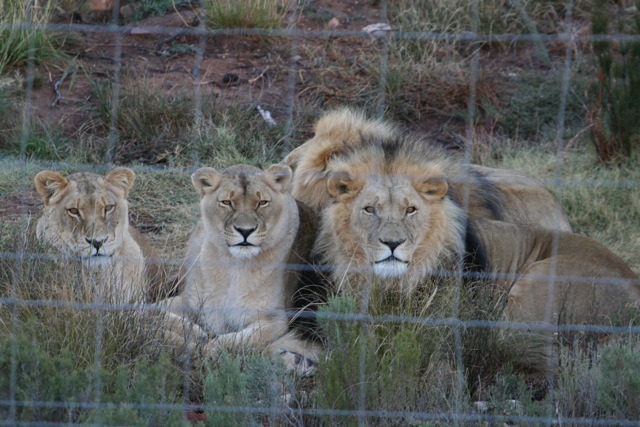
Lions at Aquila Game Reserve

Lions at Aquila

My views will not be that of the majority. I’m sure that hundreds, if not thousands, of foreign visitors are delighted to be able to put a tick next to Rhino, Elephant and Lion, all in the space of 30 minutes. For me, Aquila is a glorified zoo, selling overpriced alcohol and serving very sad food. Even on a half-price deal the visit was expensive.

The next overnight stop on our trip was Sutherland, which we reached after morning tea at Matjiesfontein. As with the rest of the Karoo, its change in fortunes is to thank for the way in which everything has been kept in its Victorian state. If business had continued to prosper someone would have felt the need to knock the buildings around and do some modernising. Thanks to hotel entrepreneur David Rawdon, the village was saved in the 60s from steady decay, and appears to do enough trade to be maintained. There are a few interesting museums, which are worth wandering around for a couple of hours.

Sutherland is much less attractive. In fact, it’s such a depressing place that I couldn’t imagine spending more than the night we did. It’s also unbelievably cold (i.e. below freezing), which is an inevitable experience when one does the outdoor star gazing thing with local buff Jurgen. It is the biggest sky you’ll ever see, and Jurgen’s telescopes enable you to see amazing sights in outer space.

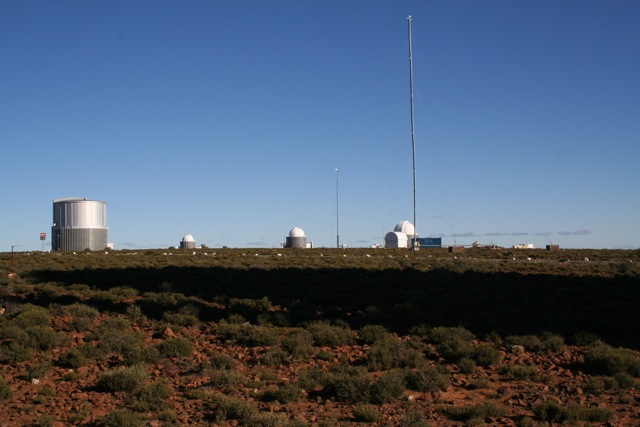
Of course, the ‘proper’ telescopes in Sutherland are a lot bigger than Jurgen’s, the biggest of which is the SALT (South African Large Telescope), which is also the biggest telescope in the southern hemisphere.

Observatories in Sutherland

The cluster of observatories in the vicinity of the SALT

From the bone-chilling cold of Sutherland we moved on to Beaufort West, where we were booked in at Lemoenfontein. This well-located establishment is just a few kilometres off the N1, on the northern side of the town. It’s convenient as an overnight stop for travellers, but it’s particularly good if you’re spending a few days. I should mention that the KFC drive-through lunch we had upon arriving in Beaufort West was most enjoyable. Yes, yes, enough of the jeering, but when you describe the Twister as a soft tortilla wrap filled with crunchy chicken goujons, chopped salad and mayonnaise, the picture does change.

The teenager had hit bit of a wobble in Sutherland the night before, and we loved Lemoenfontein from the moment we walked through the front door, so our one-night booking was immediately converted to two. The house was built as a hunting lodge in the mid-nineteenth century. Not only did the proprietor pick a fantastic spot against the slopes of the mountain, but the house itself has wonderful proportions. And, what made us really happy was the quality of the ‘table’. Both our dinners were delicious, and showed up the mediocre offering at Aquila.

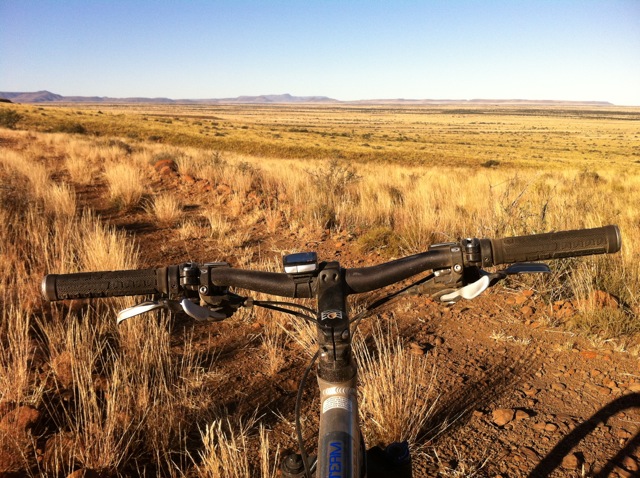
Lemoenfontein

How's that for a view from my handlebars? An iPhone snapshot during my afternoon ride at Lemoenfontein.

After two most enjoyable nights at Lemoenfontein we drove to Prince Albert, arriving at about midday. Their olive festival was in full swing (see the video I took of the Eden Minstrels here), so we had a walk around and then ended up at African Relish, where we had a delicious lunch. We stayed for a demonstration by Jeremy Freemantle (it is a “recreational cooking school”, after all), which was very interesting. Even if you’re not a foodie, African Relish is a great space to be in. Plan a weekend in Prince Albert, and make sure that you include African Relish.

It’s a shame that we left ourselves with less than 24 hours in Prince Albert, because there did seem to be a lot that we were leaving undone. We weren’t going to leave without dinner at Gallery Café, though, but getting our bodies ready for another meal required a jog around the village (or, in my case, a power cycle on the road towards the fig farm).

After breakfast the next morning we headed for a family lunch in Robertson, driving to the R62 through the spectacular Meiringspoort.

Each piece of driving had its end point, but the road trip wasn’t aimed at reaching any particular objective or destination, so the “are we there yet?” question wasn’t necessarily relevant. A road trip is all about the journey, about the interesting places one finds. More than anything, though, it’s about four people spending a lot of time together, often negotiating the itinerary while the drive is in progress. And that, really, is the point of the road trip. It’s about the people who share the journey. The route is a bonus.

A Moment of Madness

Oscar Foulkes May 28, 2011 Uncategorized No comments

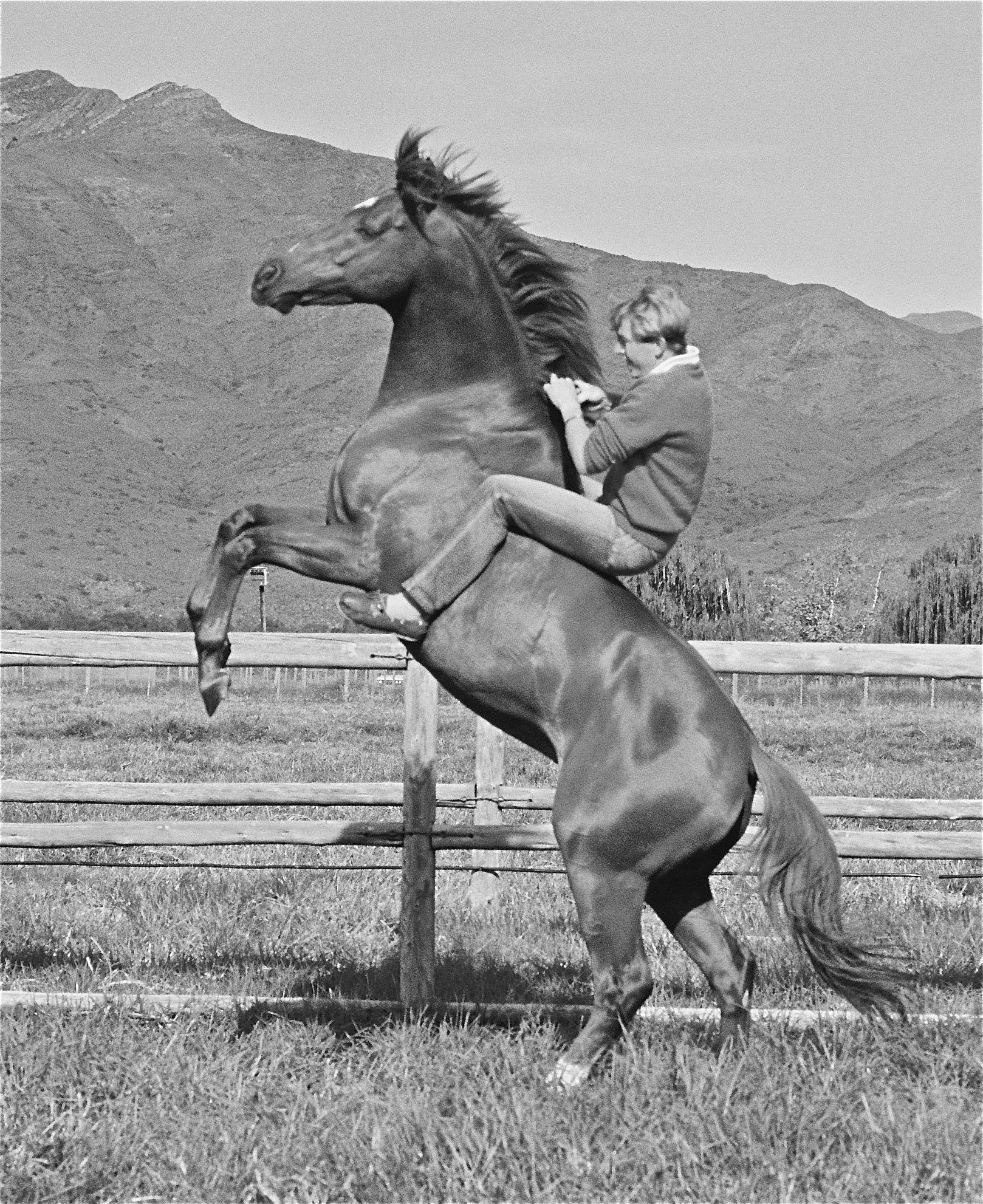
rearing stallionIn a sense, my life has been lived as a cycle of passions (some would say obsessions) that remain interests as the passion cools. Until my mid-twenties it was horse racing and breeding; don’t be fooled, though, by my apparent youth when I made the transition to wine. By the time I was ten years old I could recite male lines back to the 19th century. I may well have done my “10 000 hours” by the time I turned 25.

I did ride horses, of course, but my interest in Thoroughbreds was (and remains) their supreme athleticism. On the intellectual side, yes, I did study the form in preparation for an afternoon of punting, but I spent much more time studying pedigrees in an attempt to improve the tiny chance of breeding a champion.

These days, having spent many more than 10 000 hours branding, marketing and selling stuff, I am particularly interested in the challenge of turning the industry’s fortune’s around. The commercial side of horse racing (i.e. the entire customer experience, as well as its marketing) has been appallingly badly run. The most amazing thing is that those leading and managing the industry don’t seem to be capable of learning from their past errors.

Anyway, the picture above was taken by Charles Faull, when he was taking a break while photographing my parents’ new stallion, Truely Nureyev, about 24 years ago. I thought it would be fun to jump onto the stallion’s back and trot around the paddock for a minute, but he had other ideas. I don’t normally put myself in situations of potential physical danger, so it was fortuitous to have a camera around to record my moment of folly (and, no, I didn’t fall off).

Grazie, Graze

Oscar Foulkes May 2, 2011 Restaurants No comments

Graze, in Stanford’s main road, is a fabulous little eatery, overflowing with character in a way that makes you want to eat the entire menu. I was there for lunch after a little mountain bike ride, hence my interest in eating was even greater.

As you can see from the picture above, the menu is written on one of the walls. The theme is Italian, with antipasto-type dishes piquing lunch appetites. They aren’t licensed, so we were invited to pick something up from the bottle store across the road (I thoroughly enjoyed the bottle of 2010 Raka Sauvignon Blanc I selected from the limited cold stocks).

The place was quite busy, so a lengthy conversation with the owner, Jero, was not possible. He was wearing a chef’s jacket, but due to a staff shortage he was working front of house. In the kitchen was his wife (or significant other), who goes by the name of Catch (fancy that), according to the embroidery on her chef’s jacket. Unfortunately, we didn’t get around to establishing the story behind the name.

Bresaola with rocket, parmesan shavings and olive oil

My appetite was given even more of a rev by Jero’s descriptions of the dishes; he’s certainly passionate about food!

The meal was most enjoyable. I ordered two starters: a chickpea salad that was topped with gorgeously creamy locally made grilled haloumi, and bresaola with homegrown rocket, all served with fresh focaccia. This was less food than I needed, so it’s a good thing my friend ordered more ambitiously. The Graze antipasti board is a great way of eating; we enjoyed mixing and matching our way through it.

The Graze Board (for two)

Graze is only open on Fridays and Saturdays, which means you have limited opportunities to dine there. Be sure to make a booking the minute you arrive in Stanford.

The Eden Minstrels

Oscar Foulkes May 2, 2011 Uncategorized No comments

At the Olive Festival in Prince Albert, I used my iPhone to record this local band playing an Afrikaans favourite. The performance isn’t going to win any talent contests, but it’s a very real and typical part of local culture.

What’s not to love about a bunch of guys with this much character in their faces belting out some tunes? The name of the group is Eden Minstrels, which adds to the charm.

As extraordinary as the video and sound quality of a little hand held device is the relative steadiness of it, after a shot of Witblits!

witblits

Witblits (literally "white lightning") is a rough brandy made from fermented peaches. It's fabled in South African rural areas; even if only for research purposes I had to have a shot!

Planet Restaurant

Oscar Foulkes April 29, 2011 Restaurants No comments

Cured ham with slow-cooked egg at Planet Restaurant

As a young adult, the Grill Room at the Mount Nelson Hotel was high on my list of special occasion outings. With jazzy-type live music (and mini dance floor), plush banquettes and dark wood it pressed all the right buttons.

Most of what happens at the Mount Nelson has remained pretty much the same as it’s been for decades, which is part of the property’s appeal. However, hotel restaurants are an almost-impossible business to operate effectively – ideally they’d be a profit centre, but most of the time they are a cost centre. And, let’s not forget how fickle Cape Town’s dining out crowd is, so there’s an ongoing imperative to keep the offering fresh.

The Mount Nelson’s most recent restaurant update has been the Planet Restaurant, twinning with the hotel’s hugely popular Planet Bar. The marketing person in me isn’t convinced about this as a brand extension, but that’s a separate discussion. What is convincing is Chef Rudi Liebenberg’s food.

The main theme running through the menu is one of sustainability, which as a buzz-word is as hip as the patrons at the Planet Bar. It’s very easy to be cynical of businesses that have jumped onto the sustainability band wagon, however, having got to know Rudi over the years I can tell you that he is 100% sincere – not to mention passionate – about the direction they have taken.

It may be a boy thing, but I also know Rudi to love his kitchen toys. Again, it’s not about waving the flag of the latest fads, it’s about what ends up on the plate. So, sous-vide is a method used with several of the dishes. What this usually entails is putting the item into a vacuumed bag and popping it into water at a specific temperature (could be anything between 60 and 80 degrees) for a fixed length of time. The benefit is that the cooking happens at a temperature which retains the texture and juiciness of the meat (or whatever is being cooked). Accurately determining (and implementing) the cooking temperatures of various foodstuffs is one of the features of molecular gastronomy.

I should add that I have had a somewhat cynical view of sous-vide, mainly because my earliest experiences were of chefs using the latest toys without paying much attention to deliciousness, which surely is the ultimate aim of their ‘alchemic’ activities.

So, on to the meal. I started with what one could lightheartedly call egg and bacon. It comprised an egg poached sous-vide (the white had not denatured to the point where it was a solid white, but had turned to jelly) with locally cured ham and shavings of Gouda cheese. Garnish took the form of delicately tasty pea sprouts. I’m not one of those eaters who needs his eggs cooked to the point of bouncing off the walls, so the concept of conceptually half-cooked – but scientifically fully-cooked – eggs don’t scare me. I loved the dish, which could also stimulate debate about which part of a restaurant bill we regard as fair mark-up.

You see, this starter sells at R85, which is astronomical (what else could one expect from a place called ‘planet’) when related to the cost of the ingredients. Yet, we happily accept it. On the other hand, the mark-up on their wines is much smaller, but still at a level that could raise some diners’ ire (my benchmark, Warwick First Lady, sells for R190).

My main course was pasture-reared chicken on a curried barley ‘risotto’, that was sensational (there may well be something perverse about a meal starting with egg and proceeding with chicken). The breast, which had been cooked sous-vide, had the most fabulous texture, doing an excellent job of demonstrating the benefits of cooking at low temperature. With this was served a grilled drumstick that had been coated in popcorn. I’m not making this up. The popcorn had been cooked with chakkalakka oil, then blitzed in a food processor. The flavour and texture combination was amazing!

Save $65! SousVide Supreme Promo Package
Across the table, the food was no less delicious. I was given a morsel of braised pork cheek that blew me away. From the starter, I had a piece of salmon trout (cooked sous-vide) that had the most unusual texture (neither raw, nor cured, nor cooked).

We couldn’t manage dessert, so mopped up the rest of our wine with a shared cheese board.

As befitting an establishment of this nature, there is a six-course tasting menu, which you can order with matching wines. What sets Planet Restaurant apart – and which proves Rudi’s sustainability ‘cred’ – is the same thing for vegans. Fine dining is usually about expensive protein being used as the mouthpiece for a head chef’s ego.

Vegan cooking is something different altogether, and for traditionally-minded chefs may even qualify as a form of torture. It’s one thing to omit meat or chicken, but working without staples such as dairy or eggs – and creating six sensational courses in the process – is not the kind of cooking challenge that top chefs would normally choose to take on.

So, how successful is this as a rejuvenated restaurant concept for Cape Town’s most traditional of hotels? The whole experience is certainly grand, from décor to service to food. Of necessity, this is matched by the pricing. While costly, it’s fair, given the quality of the offering, but much less accessible than the adjacent Planet Bar. I do wonder how many of the Bar regulars would eat at the sister Restaurant, and this makes me question the marketing side of things. The situation isn’t helped by recessionary times, which have inhibited people’s willingness to splash out on smart meals.

Enough of me with my marketing hat on. The foodie in me was absolutely delighted with the experience. And, I’m about to contradict myself; in these straitened times one occasionally needs a little escapism from enforced austerity. Where better than Planet Restaurant, with its grand, traditional Mount Nelson backdrop to Rudi’s modern food?

Vengeful Customers

Oscar Foulkes April 22, 2011 Uncategorized No comments

As a marketer, it is my job to tune into consumer behaviour, whether the purchase is happening online, or in a traditional face-to-face transaction. Through my connection with Dish Food & Social I get another angle on customer interactions, generally in the form of people who have been unhappy with the meal that’s been served to them.

Of course, eating food that’s been prepared by another person (generally out of sight) is an experience that requires a great deal of trust. In addition, as I’ve written about previously (here) our dietary preferences can be tied to deep-seated personal psychology. And, as we all know, when people get close to our ’emotional buttons’ all kinds of things can happen.

As you’ll see from the picture of one of the Dish delivery vehicles above, they’re not exactly anonymous. So, last week, one of the drivers was spotted tossing a cigarette butt out of the window while driving along the freeway. The spotter had booked Dish to do some catering, and had the choice of a number of responses.

Before I get to those, I need to iterate (unnecessarily, I think) that the driver was not sanctioned by Dish to commit this act of littering. In fact, smoking on company premises – which includes the vehicles – is forbidden. Had Andrea or I seen him do this he would immediately have been subjected to the most extreme disciplinary action possible. All parts of the Western Cape are a huge fire risk in summer. Many fires are started as a result of exactly this type of transgression, in response to which Cape Town has passed a bylaw imposing specific penalties on drivers who toss cigarette butts.

We’re hugely appreciative that the spotter took the trouble to let us know what she saw. Society needs people who have a sense of civic responsibility. As a consequence we were able to impose disciplinary procedures on the driver. However, she didn’t stop there. So outraged was the spotter that she immediately cancelled the job. This, despite our most profuse apologies, expressions of appreciation for her informing us, and assurances that the driver’s transgression appalled us as much as it did her.

In recessionary times – actually, all the time – one cannot afford to lose customers, and pissing them off to this extent is really, really bad. However, we can see where she’s coming from, so we pretty much just have to swallow it.

The incident came to mind again this morning, while I was reading Dan Ariely’s The Upside of Irrationality. Chapter Five deals with the revenge that customers take against companies that upset them. He makes the distinction between principal (the company) and agent (the employee), which is not a separation that the customer makes. The customer will happily punish the principal for the sins of the agent (cold comfort for us, as we delete a nice job from our order book).

I grew up with a stepfather who would go into a state of ballistic anger without a moment’s warning, which for me, as a kid, was hugely disturbing. I don’t know whether my formative experiences with anger have had anything to do with it, but the adult me has a quiet, vaguely intellectual interest in anger as a phenomenon.

I observe a low grade of anger on many of my visits to the post office, which is something I do almost every day to despatch Nomushop.co.za orders. There are times I experience a simmering rage when trying to contact the Post Office’s customer ‘service’ department by telephone.

While in the Post Office yesterday I saw the notice above, which is worded in such a way as to increase anger, rather than evoke an element of understanding on the part of people waiting in slow queues.
For starters, there is no apology, merely a statement of fact. And, the branch manger has officiously added a post office stamp to the notice, increasing the divide between himself and his customers (although he almost certainly wouldn’t regard them as such). If, instead, he was helping out behind one of the counters, or helping to direct queues (with further apologies), much less anger would be on show.

In the case of the South African Post Office, there is no need to separate principal from agent. The manager (the agent) is acting the way he does because the entire organisation (the principal) is dysfunctional.

Given that the organisation is unlikely to change, perhaps I should get together with the butt-spotting woman (who fired us) to plot an appropriate revenge on the Post Office.

Through the use of positron emission topography, Ariely’s experiments were able to show “increased activity in the striatum” when revenge was being enacted, suggesting that “the decision to punish others was related to a feeling of pleasure”.

In other words, revenge is sweet (but we knew that already!).


A-1 Pork Chop at DW Eleven-13

Oscar Foulkes April 21, 2011 Restaurants No comments

A random Google pork chop

I went through a craving for pork chops a month ago. It started when my golf group went for lunch after our monthly game at De Zalze (lovely course, by the way). Pork chops were on the menu at our chosen lunch venue (so bad I cannot possibly mention it by name), and instantly I was imagining biting into a juicy, tender piece cut from next to the bone.

What arrived, sadly, were unquestionably the worst-prepared pork chops I have ever encountered. For starters, they’d sliced one chop into two – well, that’s what it looked like – with the result that the chops were about 6mm thick.

Mistake number one: chops need to be cut thicker, so that one can cook them for long enough to caramelise the outside, without overcooking the inside. This is especially true of pork chops, which have hardly any fat in the meat (unlike lamb chops), and therefore dry out very quickly.

The most astonishing of all, though, was the way they’d cooked it, and the effect this had on the flavour. I didn’t see the kitchen in operation, but based upon the bitter, charred flavour with hints of gas flame, my guess is that they’d done it on a gas steak griller with the flames on maximum.

A week or two later I cooked pork chops at home, which I won’t describe here at risk of sounding immodest, but they did help to quell my cravings for a bit.

Last week, while in Johannesburg, I went to DW Eleven-13 for dinner. This restaurant had been highly recommended to me by foodie friends, and I even went so far as to research the menu online. By the time I was comfortably ensconsed in my seat, with menu in hand, I already knew what I wanted to eat. Yes, you’re right, the marinated pork chop. To be precise, it’s marinated with olive oil, fennel seeds, basil and chilli, served with bacon, borlotti beans and a rich lemon pork reduction.

Save $65! SousVide Supreme Promo Package
That pork chop was gorgeous. It was more tender and juicy than I could have imagined in my wildest dreams (perhaps cooked sous vide before being finished off under the grill), and oodles of sauce with finely judged flavours. All it needed was mashed potato, which I had to order as an extra, at a stratospheric R35 for two table spoons.

Less heavenly was the texture of the mash. One certainly could never have used words like “fluffy” or “clouds”. In fact, if the wallpaper had unexpectedly started coming away from the wall the mash would have come in handy. You get the picture.

The restaurant dealt with the issue appropriately (profuse apologies and extortionate mash removed from the bill).

I didn’t have dessert, but was hugely impressed by the petit fours – chocolate truffles and turkish delight, both homemade.

By the time one has added the side order of mashed potato, the pork chop at DW Eleven-13 comes to R170, which is really, really expensive. That we’re willing to pay this much for an admittedly excellent dish says a lot about the ineptitude of other establishments.

Cooking a pork chop well is not a difficult thing, and yet so few restaurants get it right.

Eating at DW Eleven-13 is an exercise that requires some prior financial planning, but it’s forgivable, given this level of passion and excellence.

I will, however, have to find alternative ways of dealing with my occasional pork chop cravings!

A Canter down Memory Lane

Oscar Foulkes April 20, 2011 Uncategorized No comments

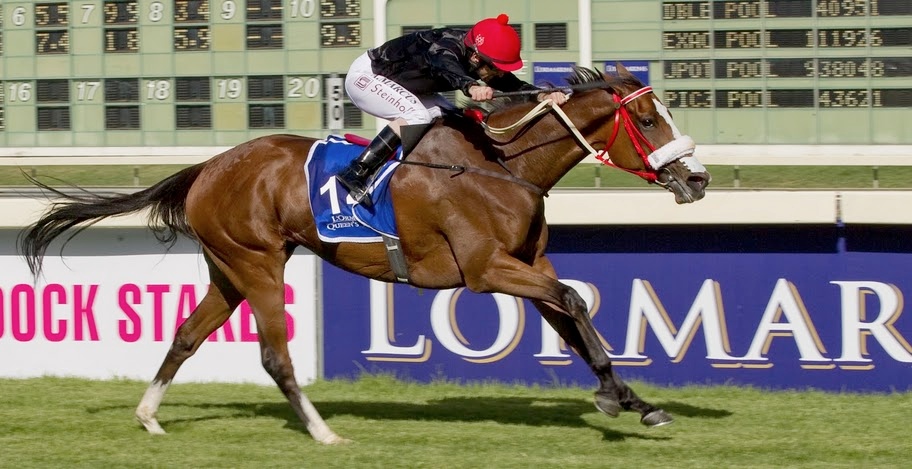
Mother Russia, bred by my mother, wins the Queen's Plate, South Africa's most important 1600m race.

I took a walk down memory lane (or should I say, a trot down the back straight) by attending the National Yearling Sales in Johannesburg over the weekend.

Until 18 years ago it was an event I participated in every year, both as a small-time buyer (representing Form Bloodstock) and seller (assisting my parents’ Normandy Stud). In fact, when I was still at school the sale did double duty as family holiday (presumably because it involved a trip to Johannesburg). It’s the most important horse sale of the year, and represents the majority of breeders’ annual income. Assuming they sell their horses, of course.

The sale is conducted as an auction, which means that vendors don’t have a great deal of control over the final price. While many prices probably are a fair reflection of the ‘value’ of a horse, gross inequities do pop up. A vendor can protect himself by using a reserve price, but ultimately the best prices require two determined bidders.

What I can report about this year’s sale is that it was jolly hard going. The majority of horses sold at reserve, or below, and very few involved a spirited contest between two bidders. Buyers shopping between R100 000 and R250 000 had the pick of a large number of good-looking, well-bred individuals. Given a choice of buying one horse for R2 million, or ten for R200 000, my money would be on the latter. Especially this year.

The reason for my attendance was to stand in for my mother, Veronica Foulkes, who cannot travel to altitude following a recent eye operation. Apart from watching the odd horse race on TV I’m completely out of touch with what’s happening in the industry, so it was an act of extreme parental trust for her to hand over the reins to me.

When I last attended the sales I had a different kind of emotional involvement, and at times I found it to be extremely stressful. This time – while I obviously wanted to get the best result possible – I could be more detached from the emotion side of things. I had been helicoptered into a situation that required me to understand the market environment and to develop a strategy for each lot from that point. So, a critically important part of the process involved identifying realistic levels at which to set reserve prices. In a select few cases, I came to the conclusion, it’s better to have no reserve at all. The reason for this is that in these cases the horse is “on the market and for sale”, so it’s easier to attract a bid at the floor price (R50 000), which then seems to draw further bids from other bargain hunters.

Part of my duties also involved collecting some awards on behalf of my mother, for each of the Grade One winners she bred in the past 12 months. Based upon the number of foals she produces, she statistically shouldn’t breed more than one Grade One winner every eight years. And yet, in the calendar year 2010, she bred three!

2010 wasn’t a flash in the pan. She’s been outperforming the averages by a wide margin for many years (click here to read more). When one factors the cost of her bloodstock into the equation she’s outperforming by an even wider margin. I have to admit to shedding a little tear or two when walking from the podium with the trophy for Mother Russia’s Queens Plate victory, both out of pride for what she’s done, and because she wasn’t there in person to receive the accolades.

One of my tasks, also, was to thank the buyers after each lot was auctioned. Some of the people I do know, but 18 years is a long enough time for many new participants to have entered the industry. So, I went up to one successful bidder and thanked him, after introducing myself.

I thought I heard him say, “You need a beer”, to which I was on the point of replying “no thanks, I’m driving”. After all, my voice was particularly scratchy, so a little lubrication wouldn’t have gone amiss.

Instead I leaned closer and apologised for not hearing first time around. This time I heard his name, loud and clear, “Coenie de Beer”, which in a noisy environment could sound as if he was offering me a drink.

I think I’m OK with saying that I left school 26 years ago, but it does seem really weird that something out of my adult life – especially something that feels so recent – should have happened 18 years ago.

Memory Lane is a road that gets longer with every step we take. Then we start forgetting stuff.

Beauty & The Beast

Oscar Foulkes April 3, 2011 Uncategorized No comments

Beauty: approaching the highest point on the Vigne-a-Vigne mountain bike ride

This morning’s Vigne-a-Vigne mountain bike ride (someone of my ability couldn’t possibly call it a ‘race’) zig-zagged around the hills and mountains above Lourensford Estate in Somerset West. It is one of the most spectacular organised mountain bike rides of the year … but not for the faint-hearted. Take a look at the route profile below:

The Beast: the route profile

Regardless of my limited athletic ability, the point of the exercise remains to get around the course in the least possible time, so my iPhone was only pulled out a couple of times. Here are a few more pics:

Another view of the Hottentots Holland mountains (to the left of the pic at the top).

The ride takes place on the Somerset West side of the mountains, in the 'bowl' above Lourensford. From the point marked Nek on the route profile one has a fabulous view over the Stellenbosch vineyards, which are on the other side of the mountains.

And, finally, for reference here is the landscape from the perspective of the Google satellites:

The 'Lourensford bowl' from above