some image

Having fun, writing about the stuff I like

The Making of a Digital Creature

Oscar Foulkes July 19, 2013 Uncategorized No comments
Earlier this year, I came to the realisation that the business services I offer fall within the niche known as ‘digital’. To be honest, for someone who has made a career of marketing and selling stuff, I wasn’t great at selling my own wares. In fact, it could be said that I was floundering.

The key problem was that I was struggling to narrow my focus. I didn’t want to exclude opportunities by taking offerings off the menu. But, I also knew that a narrowly defined offering is much more likely to result in word-of-mouth, the casual chats that happen between friends (or even just acquaintances) and which lead to business opportunities.

Settling on digital was easy. Firstly, almost all the projects I’ve done over the past three years have involved ecommerce, web development, games, apps, social media, or emailed calls-to-action. Secondly, I am passionate about the medium. Generation X (of which I’m a member) is probably the last generation that will not be entirely digital. The onus on companies wanting to grab Generation Y (and beyond) as customers is to get themselves into the space in a relevant manner, but companies are generally run by older people, many of whom are either skeptical or scared of this digital world.

At the age of 46, I’ve done enough old-school commerce to be able to make this new frontier accessible to decision-makers.

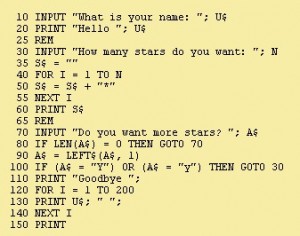
So, how did I get here? In a sense, the seeds were sown when I was a teenager at boarding school. A friend had been given a ZX Spectrum, followed by a Commodore. At about the same time we were also taught BASIC as a little bit of extra-curricular inspiration. Despite the minimal processing power, we knew this was super-exciting space to be involved in.

But, for me at that stage of my life, horse racing and breeding held a greater allure, so I never developed much beyond that early interest. In about 1988, the small company I was involved in made the move to desktop publishing, with a Macintosh networked to an early-generation PC. Soon after, we started building a database of South African horse racing and breeding. I was the internal IT guy, and ended up being self-taught in all the software we used, as well as setting up and running database queries.

From my late-20s I made the move into wine. I remained tech-aware, in that computers were a constant tool, much as they are for any other working person. I commissioned websites, but I was a little intimidated by the technical background. That was until I built my first website in 2008. As is my pattern, I learned by trying it out for myself, and just kept going.

What makes my offering unique, I believe, is that my primary interest is in digital as a tool. In other words, what is the utility of the thing? How does this benefit the end users? No matter how entangled I’ve become in the tech side of things, my sights remain set on the human beings who use the tools.

Which brings me to the new name, because there were already several similarly named businesses operating as digital agencies. What about just, “Oscar”, suggested my wife. Yes, said I, JustOscar is an excellent idea.

Outgoing Mail Server Solution

Oscar Foulkes July 18, 2013 My Little Black Book, Web Tools No comments

As we move around with our mobile devices, switching between 3G connection and various WiFi networks, outgoing mail settings (SMTP) are as much an issue as when we moved around with laptops only.

The reason for this is that each connection to the internet – whether via LAN, WiFi or mobile – uses its own SMTP server. There’s no problem receiving mail using all these various networks, but if you want to send mail you need to change settings. The problem is this – in most locations no-one knows what the SMTP server is for that network. And, even if you could find it out, who wants to be bothered with adding new SMTP servers?

The solution is one I’ve been punting for several years, smtp2go, which is one outgoing server you use wherever you are, on all your devices (you can read more about it here).

(Disclosure: I earn a small referral fee as a result of sign-ups that originate from this site)

Playing With Food – Bay Leaves

Oscar Foulkes July 17, 2013 Uncategorized No comments

I was quite pleased with this little bit culinary ingenuity, if I say so myself. It’s entirely possible that someone has done this before, but seeing as Google searches on “bayleaf salt” (and variations) produce gazillions of results for the Bayleaf restaurant in Salt Lake City, cyber evidence of this is not easily at hand.

OK, so here goes. Bay leaf is one of my favourite herbs, but the hardness of the leaves means that using them is not straightforward. Well, not like basil or thyme, for example. For dinner a couple of nights ago, I was keen to get the fresh bay leaf taste into some steaks I was cooking. So, I tossed a handful of bay leaves into a mortar with a few tablespoonfuls of salt and pestled it until the salt had turned green. I seasoned the raw steaks with the salt about 45 minutes before cooking them.

I was delighted to discover the bay leaf flavours well-infused into the steaks. Yum!

(I’d be interested to hear about other interesting herb salts, so please feel free to leave comments)

The Supercar Road Trip

Oscar Foulkes July 9, 2013 Uncategorized 1 comment

Golden Gate Park

“We are not thinking machines,” claims neurology professor Richard Restak, “We are feeling machines who think.” This statement implies that we humans are not quite as rational as classical economists would have us believe, and ties right in with the work of Dan Ariely, Daniel Kahnemann and others. Essentially, people who operate with the dispassion of Mr Spock (OK, I know he’s only half human) are as much a fantasy as the entire Star Trek storyline.

The motor vehicles I’ve owned have all been selected on the basis of practicality and affordability. And, even if I could have afforded something sexier it’s unlikely I would have bothered because I’ve never been any kind of petrol head. So, for me motoring has been all about thinking.

On a purely rational level, sports cars – whether they fall into the supercar bracket, or not – make no sense at all. Most of them have no space for golf clubs, they would look really stupid with a mountain bike hanging off the back of them, there’s hardly any space for people, and they spew greenhouse gases. That’s before one has filled the petrol tank, bought a R30 000 set of tyres, or anything related to keeping it on the road.

But, jeez, when you paddle down a gear to pass another vehicle and go roaring past in less than a second, or fly around corners at impossible speeds, that’s a feeling that is powerful enough to convert even the most staunch auto agnostic. And, of course, the feeling is spontaneous, involuntary, just smacking you in the gut, no computation required.

I spent a week in June as a guest on the Rogue Rally (loads of images on their Facebook page), during which 40-something supercars, comprising most of the best-known marques, sped around a variety of roads, racetracks and even along an Air Force runway. Driving in that convoy (while we were able to hang onto the back of it) was a huge thrill. Apart from the speed, there was also a huge sense of occasion – how often does one have that many Porsches, Ferraris, McLarens, Lamborghinis and others all sharing the same road? Wherever we went, people formed instant crowds, taking pictures on a variety of mobile devices.

Yes, every part of it was wrong. The expense, the speed, the carbon emissions, you name it, but damn, was it fun!

We had a track day in Welkom. In Kimberley, there was a 400m drag race, which got very interesting when the farmer who owned the adjoining land gunned his Toyota Hi-Lux straight at the oncoming McLaren and Porsche, forcing them to veer off the road. It could have been very messy.

In Bloemfontein we raced radio-controlled cars (actually, we kept crashing them). Then, we drove through the magnificent Golden Gate Park en route to Dullstroom. The following day we drove over the Long Tom pass to Graskop, where 2.8 km of national road near God’s Window had been closed for us. Each car had several runs on the empty road, which was a heap of fun (my host let me go two or three times).

After overnighting in Hazyview we drove to the Hoedspruit Air Force base, where we had a morning of racing on the runway. From there, we drove to Pilansberg via Magoebaskloof.

I love a road trip, and this was a particularly good one (even though we dodged hundreds of potholes). There was banter with the fellow participants, many of whom are from completely different backgrounds. There were party nights. There were comedians, DJs, a beat boxer, Zulu dancers and Kingsley Holgate. The landscapes – all of them – were beautiful. There was even a Samsung Galaxy S4 that fell into a soiled toilet bowl – and kind of lived to tell the tale.

Sometimes we think too much. We just need to DO and FEEL. We may be amazed by the new experiences that we end up enjoying (even if they are wrong on every rational level). I was.

Digital Tools for the July

Oscar Foulkes July 5, 2013 Uncategorized No comments

In the old, paper-based days, the most important sources of Thoroughbred information were the Stud Book and the Racing Calendar. The former recorded the foals born over a designated period, along with their sires and dams, while the results of each season’s races were published in the Racing Calendar. As long as you had access to the books, all the information was available, but any research took days.

All this is tailor made for databases, accessed in seconds over the Internet, whether from computers or smart phones. Of course, when Charles Faull’s team at Form started digitising this type of information in the early 90s, Tim Berners-Lee had only recently proposed the World Wide Web, and first generation mobile phones were not yet on the scene. It took years before PCs achieved the processing power and storage capacity of today’s smart phones.

Over the past year I’ve been working with the Form team in creating several digital resources for horse racing, the most recent of which is the full record of the Vodacom Durban July, all the way back to Campanajo’s victory in 1897 (www.julyhandicap.info – much of the history unfortunately switched off for maintenance at the moment). As you scroll through the results, you see that it truly is the ‘July’ handicap, with the biggest deviation coming in 2010, when the FIFA World Cup pushed the July out to the 31st.

A horse race – especially when contested by champions – is a dramatic event, worthy of a poet’s best efforts. But there is some fairly basic and inviolable science that fells the efforts of all but the very mightiest of equines.

Newton’s Second Law is as valid now as it was 300 years ago. Put simply, the weight carried by a racehorse has a measurable drag effect. This, of course, is the basis for the handicap. Since 1970, just three top-weights have won the July, which says something for the power wielded by the handicapper.

One of the most significant components of JulyHandicap.info is the FMR (Form Merit Rating), which reveals some colossal performances by horses who never won the July. The mare Olympic Duel carried 57.5kg to a one-length third behind Spanish Galliard (54.5kg), Model Man (57kg) ran the three-year-old Bush Telegraph (49kg) to a length and a quarter, and any discussion about weight-carrying in the July would inevitably include William Penn who carried 26 lb more than Chimboraa when he finished half a length back in second. Or, how about Milesia Pride getting beaten a length and a quarter in 1951 when he carried 37 lb more than the winner?

With this merit assessment as a foundation, the team has also produced a mobile-based preview of the 2013 Vodacom Durban July, along with a complete race card of the day’s racing. Whatever smart phone you’re carrying – as long as 3G bandwidth is not overwhelmed at Greyville – you’ll have the entire day’s racing on your phone. Visit RaceForm.info to get the inside track on all the July Day action.

You Will Buy From Us!

Oscar Foulkes June 14, 2013 Uncategorized No comments

Being in the marketing and sales arena myself, I find it intriguing how companies address the issue of getting their customers to buy (or enticing people to become customers in the first place). I received the letter below from a large courier company, with whom I opened an account some time ago. However, I never got around to using it, because at the same time I’d been using Citisprint for some stuff, and ended up using them more and more, because their rates are good, service efficient and friendly. You get the picture.

So, at a time when a charm offensive might actually be more effective, this is the letter I got from the Large Courier Company:

To whom it may concern

We are attempting to address an issue previously communicated with yourself regarding the zero trade on your account.

We at XXXXXXX would like to assist you as we realize you have not billed with us for a period of 6 months and longer. We have an alternate arrangement that might benefit you with your current needs in terms of a once off shipment that your company might be sending every so often. We have drop boxes situated at selected Pick n Pay and Caltex Freshstop stores in Cape Town for your convenience.

From an administrative point of view I am confident that you will understand our needs in terms of the closing of an inactive account as it becomes a tedious administrative issue. We have and always will appreciate your business partnership with us and will always be available to meet your needs once again when your business has the necessity to do so. In the interim the accounts will be closed off so as to simplify our procedures from an administrative point of view this decision is measured by the fact that for consecutive month periods there was no activity on your account.

Thanks for your understanding.

This is a prime example of the Accounts/Admin tail wagging the dog. An account with zero transactions cannot possibly cost you anything to maintain. Goodbye, Large Courier Company.

(Oh, by the way, you do know my name, because I filled in a multi-page document that extracted reams of personal information. Addressing me “To Whom It May Concern” is proof enough that I am better off without you).

Brushes With Art

Oscar Foulkes May 29, 2013 Uncategorized No comments

A few months ago (in March, to be precise), I started noticing little rainbow flashes below streetlights lining my various routes around Cape Town. It’s amazing how such small things – almost always in peripheral vision, especially for a driver – can become so visible. I later discovered that these were crystals that had been installed as part of Infecting the City.

There is an obviously aesthetic element to refracted light, but I particularly loved the element of surprise. There was no fanfare or announcement; the artist spent a week hanging them, and then left them awaiting discovery. What a cool way of infecting the city, I thought.

I’m not going to attempt a definition of art beyond the aesthetic, or its potential to provoke or stimulate thinking.

In the name of art, photographer Clayton Cubitt has filmed a series of women reading from a favoured book. They are seated at a white table, the background is draped black and they are dressed elegantly. Out of sight, under the table, the photographer’s assistant is applying a high-powered vibrating massage device, with generally inevitable consequences. This aspect is not revealed during the video, so from the uninformed viewer’s perspective, the woman initially experiences difficulty in reading fluidly, eventually stops reading altogether, recovers her composure, and then ends the reading.

Even though Stoya (the above video) is in porn, the experience held its own surprises for her, as she writes about (here). You may also want to have a read of Clayton Cubitt’s interview with Salon.

Sexuality is such a complex issue, with so many sensitivities around it, that one could probably do just about anything with a sexual angle and get away with calling it art. Provoking thought or conversation is pretty straightforward in this territory, and the voyeuristic component of material with a sexual angle ensures that it ticks the aesthetic box.

In a sense, sexuality is hidden from view in much the same way as the colour spectrum hides within ordinary light, until refraction reveals its beauty. The rainbow flag, as a gay symbol, represents diversity, but in this context it could be just as meaningful to all the rest of us.

Instead of glowing with the joy of a confidently lived sexuality (dare I say “pride”) most of us live in the spectrum between discomfort, lack of confidence and outright shame, with a few little flashes of rainbow…

Oscars, wild and otherwise

Oscar Foulkes April 26, 2013 Uncategorized No comments

I am certain that I have encountered more dogs and parrots called Oscar than people. I’ve even ridden (and fallen off) a horse called Oscar. I have recently come across a few pre-teens called Oscar, but other than my neighbour swearing at her dog, I hardly ever hear my name unless someone is talking about/to me.

The thing about a name like Oscar is that its rarity removes the need for appending a surname. So, “Oscar” will be used in conversation and people will usually expect that everyone around them knows who is being spoken about. Peter, Andrew, Michael or John are the types of name that are generally used in conjunction with a surname.

Even the Academy Awards aren’t a problem, because Oscar is always preceded by ‘the’. I may not be the world’s most humble person, but I’ve never considered myself as The Oscar. The Donald? Well, that’s another story.

Oscar Pistorius changed all that. All of a sudden my name was being used in conversation all the time, and given the background (as explained above) I initially thought that the conversation involved me.

It made me quite gun shy, if you’ll excuse the expression.

It’s all calmed down, thankfully, but when the matter gets to trial – with accompanying media frenzy – it’ll start all over again. In preparation, I’ll train myself to ignore anyone mentioning my name. If I don’t, I could end up with a case of acquired Tourettes.

More than 50 Shades of Kak

Oscar Foulkes April 24, 2013 Uncategorized No comments

Kakonomics is based upon the type of exchange where both parties are complicit in sub-standard delivery while professing a desire for top quality.

I wouldn’t say that my relationship with the Post Office has reached the point where my side of the exchange is done at a discount, but I certainly appear to be edging into a state of docility. The institution has progressively been rolling out a new point of sale system, to replace one which cost a fortune in software royalties. The cynic in me assumes that the new system had to have been the subject of a rigged tender, at a vastly inflated price, but I have no evidence, so cannot make the allegation.

What I know for a fact, because I’m at the receiving end of it, is that the new one is crap. Transactions take much longer to process. Some transaction types cannot be processed, and payment by card hardly ever works.

The first few times that I proffered my card in payment, only to be told that they could accept cash only, I got all huffy. Now, I’m ashamed to admit, I drive to the Post Office via an ATM. I do a quick mental calculation of what I expect the total to be, and withdraw that amount of cash.

I’ve given up on being huffy. Instead, I stand there like an impotent patsy, with R2000 in my pocket.

Card payments earned me eBucks on every transaction. Now, I expend my time – and some bank charges – in drawing cash.

A constant feature of the Post Office, regardless of which point of sale system they use, is that delivery of international mail is not only inconsistent, but also devoid of any useful tracking information.

I saw Bruce Whitfield quoted as saying that, unlike most private sector companies, the Post Office cannot be shamed into doing the right thing. That would explain why the organisation can get away with being as crap as it is. The absence of alternatives means that we’ll just continue to suck up the abuse, because that’s what it is.

In exchange, I’ll occasionally make public comments (such as this one) about the Post Office’s extreme crapness. I’m not sure if my reciprocal verbal abuse qualifies the exchange as Kakonomics, but there’s certainly plenty of ‘kak’ in the experience.

Click here and here and here for past expressions of frustration at the Post Office.

Is it really not “about the bike”?

Oscar Foulkes April 16, 2013 Uncategorized No comments

My Facebook timeline appears to have been invaded by cat memes. You know, those ones where a little bit of wisdom or humour is overlaid on a cute cat picture. Last year, it was all about the six-pic series relating to What I Really Do. There may have been one doing the rounds built around cycling, but with the theme of What I Really Look Like.

The point of mountain biking is to have fun in beautiful landscapes. If one excludes the possibility of broken collarbones, shoulders and wrists, it’s supposed to promote good health.

The majority of us have no hope of getting anywhere near the front of the race, and we come in all shapes and sizes, but at some point every one of us – as we go belting down single track, or weaving through trees – maps the experience onto pictures we’ve seen of pro riders doing the same thing. It’s sad, I know, but it makes for a good meme.

There is quite a wide spectrum of ability and fitness amongst us amateurs. Like weekend golfers, we start coveting better technology. Bigger wheels (29-inch) and lighter bikes (carbon frame) top the list.

It’s an arms race of sorts, which I have also joined. First it was the move from entry-level hard tail with old-fashioned block brakes to full suspension and disk brakes. The next jump was to carbon frame with top-of-the-range tubeless 29-inch wheels.

My first moment of technical inadequacy came when I wanted to remove the front wheel. The new technology here is the Maxle – effectively an axle that screws right out, instead of having attachments on either sides of the fork. I had to watch a YouTube video to learn how to do it.

Then, when the fabulous tubeless tyres had a slow leak, I discovered that I should have been topping up the sealant on a regular basis. Once again, there was a key ‘trick’, because the tyre needs to be reinflated in such a way that enables it to seat against the rim, thereby trapping the air. Doing this by means of a hand pump doesn’t work, because the air just escapes before the pressure inside the tyre forces it to seal against the rim. The only way to achieve that is to give it the full force of a CO2 ‘bomb’.

So far, so good.

After my experiences this weekend I can report that I have hit the wall. When it comes to technical proficiency I have reached the limit of my capabilities.

I decided that my brake pads needed changing (at just under R500 for the set it’s a lot less than the cost of brake pads for a car, but on a cost-per-kilometre-covered basis I’m sure the bike’s pads are more expensive). So, I dashed off to the bike shop just before closing time on Saturday. The shop owner gave me a little explanation of what to do.

Upon removing the worn pads I first had to depress the pistons that activate the brakes when the handle is pulled (it operates on a hydraulic system). If this is not done, the pads won’t fit, because the new pads take up more space than the worn ones. After losing all the fluid in the front brakes and failing completely in getting the rear pistons to budge, I gave up. Far from performing some maintenance that would keep the bike in tip-top shape I had rendered it unrideable.

I’ve always associated pistons with the internal combustion engine. Who would have thought they play a key role in enabling a human-propelled vehicle to slow down?

I may yet cling to the illusion that I’m a racing snake, a bike-riding machine, but I have no problem in relinquishing any claim to knowledge about the technical side of bicycles. What I Think I Know, and What I Really Know, as well as what the Bike Mechanic Thinks I Know, are all the same. Nothing.