
My friend, Piet Viljoen, publishes an email newsletter every Thursday. Reading it is one of the highlights of my week (click here to join it).
A newsletter largely dealing with investments, especially of the sort that are bundled together in a way that can weather an economic apocalypse, is not the usual place to learn of cutting-edge music. But Piet is someone who looks, thinks and questions broadly, so music is a regular feature.
Last week he introduced Angine de Poitrine, which I subsequently discovered is the subject of many reaction videos on YouTube. There’s a lot going on in their music, so the input of skilled musicians was essential to me understanding what’s happening musically.
Feel free to jump straight into a video or follow the story as I’ve been able to piece it together.
Two musicians, a drummer and a guitarist, begin playing together as adolescents. They progress to adult careers, the details of which we do not know because their international fame has come on the back of this project that involves their identities being hidden by costumes. More on that later.
A key feature – or requirement – is a custom-built, double-necked, microtonal guitar. In essence, it’s a guitar stacked on top of a bass guitar. Additional frets enable the guitarist to play notes between the main notes. This is what makes it microtonal, which is a sound often associated with Middle Eastern music.
Crafting this instrument took the luthier at least 150 hours over the course of three months. It seems unlikely that he will again accept such a commission.
When playing, the guitarist switches between his two guitars, recording loops on the one, which he plays over with the other. Layers are built on each other, there are great riffs, he’s managing the loops and somehow the drummer is in synchrony. The tempo builds and they even change the time signature without it seeming it weird.
It’s a great sound. Could I listen to in the same way as I listen to The Rolling Stones, for example? I don’t know, but I love what they’ve done creatively.
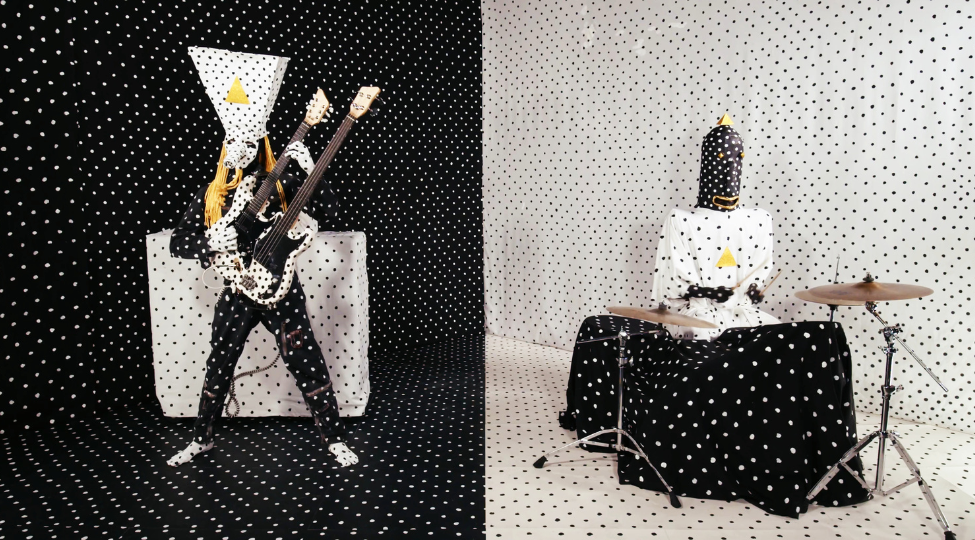
The first time they took to the stage as Angine de Poitrine, they wore costumes to hide their identity. It seems the look was assembled in a hurry, so one does not know the level of intentionality behind it all. Their costumes, as well as the draping on the set and over the drum kit, is either black with white polka dots, or white with black polka dots. This extends to painting of the guitarist’s hands and feet, as well as the drummer’s hands.
The mask worn by the drummer is a cone raised from his shoulders so that his eyes peer through the mouth aperture. The nose on his mask is bulgy and floppy, whereas the guitarist’s is a beak, something like a plague mask.
The guitarist’s bare feet allow his impressively prehensile toes to control the equipment that records and plays loops.
There’s a lot on the go, both visually and musically. Within this apparent craziness, not to mention costumes that limit vision, there is technical brilliance in the way the two (three?) instruments are synchronised with each other and with the loops. It’s all happening at a tempo that wouldn’t be out of place in a techno set.
Given the complexity of the performance, it’s probably a precondition that the two musicians should have been playing together since adolescence.
Watching the reaction videos is a rabbit hole that’s well worth losing yourself in for a while. I know nothing about music, so this is my ‘reaction piece’ from the perspectives of things that I understand.
There is commentary that Angine de Poitrine is an anti-AI music statement. Even with my limited knowledge I’d assert that it’s highly unlikely that current AI models could have written the music. Regardless of the costumes hiding the people, I like that we can see the human hands and feet performing the music. This takes a lot of dexterity!
I love that the commentary is so far removed from the type of us and them discourse that characterises the political and cultural landscapes. It’s devoid of anger, grievance politics or name calling. The reaction videos are produced (mostly) by people who seem to be accomplished musicians themselves. They are studying to understand how the music was made, and they are listening for enjoyment.
The big reason I’ve been stuck on Angine de Poitrine since last week is what it demonstrates about creativity. It comes down to two long-time collaborators jamming, doing it for the fun of what they are doing together, rather than fame or money.
There are many musicians around the world sufficiently skilled to play the music. As you’ll see from the reaction videos, anyone can comment on the music. On the other hand, being able to create it in the beginning takes a big shift to an entirely new framework. Apart from their willingness to venture into the unknown, the polka dotted duo also had to badger the luthier into taking on – and completing – a project that seems to have taken him to the limit.
We live in a world that celebrates great achievements once they have arrived on the scene. However, aspirant creatives must fight their way past resistance to change and apathy, if not outright negativity. Wrestling great ideas out of our brains is just the first part of the struggle. Update: after posting this, I received Nick Cave’s Red Hand Files email that gives a brilliant insight into the creative process.
Closing the … um … loop on music and investments, conceptually, the recorded loops are a derivative of the guitar playing. Financial derivatives introduce similar levels of complexity, except that the stakes are much higher.
Piet’s clients can rest comfortably knowing that he prefers his derivatives in musical form. He wouldn’t be seen dead in a costume of any sort, and as a cyclist, he prefers his polka dots to be red.