
Star light, star bright,
The first star I see tonight;
I wish I may, I wish I might,
Have the wish I wish tonight.
My phone rings. Instantly, I have gone from the deepest sleep to hyper alertness. I answer, to tell the nightwatchman, Kenwin, that I’m on my way, then jump out of bed to pull on enough clothes to be comfortable on a cold spring night. As I step out of the house, I look up, feeling awe at the sight of a clear sky, momentarily considering infinity. Orion’s Belt is the first constellation I see, and then the Southern Cross when I turn right towards the stables.
When I reach the foaling area, Kenwin is standing to one side while the mare circles. The foal’s legs are only just protruding beneath the mare’s tail, but she won’t settle until she is feeling ready. She goes down, the upper part of her body upright, rests like that for a minute and then rises again. Eventually she lies down, head flat against the straw, and starts pushing. This is our cue to begin assisting. Each of us grabs a leg above the fetlock joint, waiting for her pushes before we pull. It’s a big foal, and the mare is putting in a big effort. Once its shoulders are out, the rest of the body pops out easily.
Kenwin grabs a towel to rest the foal’s head on, clearing fluid out of its nostrils. The foal has only just emerged from the uterus and already nature’s hard coding has taken over, its head moving from side to side to find its mother. We drag it to the mare’s head, and she starts to lick her foal. Within a few minutes, it attempts to stand, which at this stage is nothing more than haphazard scrambling.
Birthing complete, I head back to bed, but I know that sleep won’t be quick in returning. Kenwin, meanwhile, will wash the mare’s udder and milk her to bottle feed the foal so that we know it’s had a good dose of immunity boosting colostrum. With this done, we leave the rest to nature.
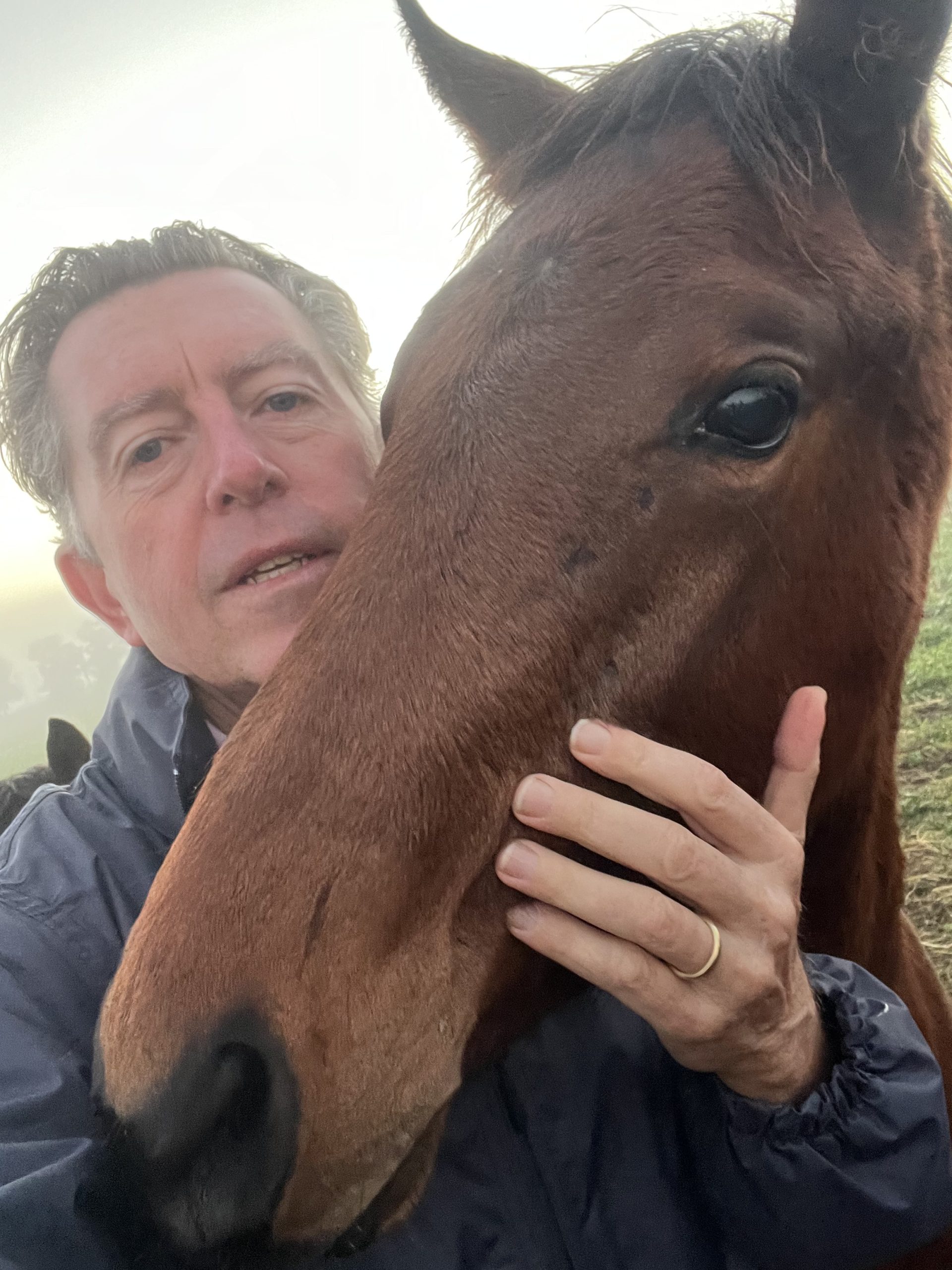
I’m up early in the morning to do a complete walking tour of all the horses on the farm. The broodmares can’t be bothered with my presence, happily grazing away, but the yearlings (last year’s foals that had their official birthday on 1 August) demand all the attention they can get. When I turn away after delivering ear scratches and more, some follow me, gently nudging my back as a way of getting me to stay for more. Equine therapy, indeed.
I walk slowly through the mares with foals, imagining what might be for the ones that catch my eye. The first step is the sales ring in about 18 months, followed by their racing career. Money in the sales ring keeps the business going; wins on the racecourse are what keep me going.
These foals, after an 11-month gestation, are the products of our work in the previous breeding season, and in these months we’re ensuring the arrival of next year’s foals. The vet arrives later in the morning to do ultrasound scans of the mares in season. I stand with the vet, both of us intently watching the screen for the clues that will determine how soon the mare needs to be covered. We’re looking at the size of follicles, the state of the uterus, and how this has changed since the previous scan. I log all this on an app that I vibe coded and get onto WhatsApp to find out from the studs what covering slots are available for the stallion allocated for this mare. Artificial insemination is not permitted, so the mare must travel to the stallion. Some of these visits involve a seven-hour round trip.
The vet is also scanning for ovulations in mares covered earlier in the week, ideally within two days of cover, but some stallions’ semen can last for five days. An ovulation sets a timer in motion, because 14 days later we can scan for pregnancy. Having lined up the upcoming coverings, we now turn our attention to new pregnancies. These involve both the vet and myself watching the screen with particular focus. The sight of a perfectly round black dot, roughly 15 mm in size, has me whooping in excitement, because the mare has been difficult to get in foal. The vet allows herself a little cheer; for her this is professional satisfaction in getting the result that we’re all working towards.
The following day I take a drive to see our two-year-old fillies in pre-training. They left the farm over two months ago, woolly-coated from spending the winter outdoors. They’ve since been backed, and with a good build-up in their training, are ready to be asked to gallop a short distance on the track at some speed. Some weave their way from left to right, shying at a bird by the side of the track, and then there’s a filly that puts her head down with purpose, running in a straight line, her legs reaching out to cover the ground with the biggest stride possible. There is a long way between now and her first racecourse appearance, but for a moment I allow myself to feel excitement at her athleticism and wonder if she’ll be the star that makes this all worthwhile.
This time of year gives me a vantage point from which to observe four crops in one go: two-year-olds, yearlings, foals and foetuses. This sport and industry being what it is, that’s a whole lot of hopes and dreams.
Fuelled by aspiration, breeders sometimes turn to celestial references for the names of their horses, the most famous of which was Eclipse, born during a solar eclipse in 1764 and to whom nearly all modern Thoroughbreds trace their male line. My only attempt at a name from this genre is a filly called Venus, who after two starts as a three-year-old remains a work in progress.
I’ve never learned to use the Southern Cross and its pointer stars to accurately mark due south. It’s enough for me to know that it generally indicates a southerly direction. Even this approximation is an infinitely more specific guide than the confidence with which anyone can chart a route to a champion racehorse. The best we can do is to make an informed guess, sustaining ourselves on dreams until we find one. If we ever do.