
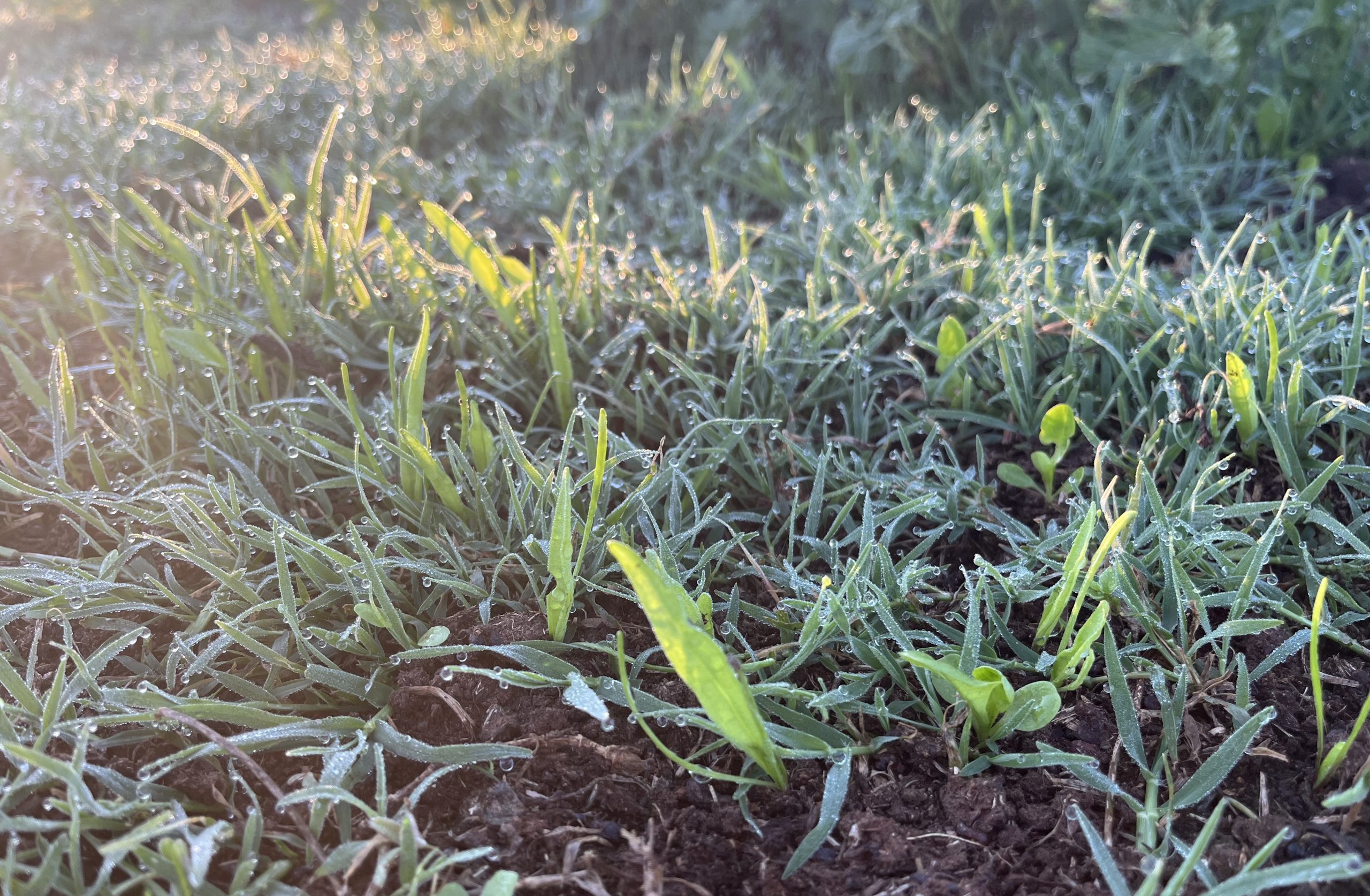
The first glimmers of green that signal successful germination is a little bit of magic that never fails to delight me.
Like many children, I sprouted beans between two layers of wet cotton wool. These days, I buy seed for pastures in 10kg increments, but my excitement remains as naïve as when I was a kid.
Bear with me for three paragraphs that get a little technical; I’ll get back to general interest shortly. On the stud, we don’t have the space or time to plough up paddocks, so we overseed. How it works is that we spread the seed, before sending the horses into the paddock for a week to tread the seed into the soil. Ideally, the soil would already be a little wet from recent rain, and we certainly want rain when the horses are about to be moved to another paddock.
The picture above is of ribwort plantain and chicory seedlings poking out through cynodon, which seems to be a good base for overseeding. Cynodon is extremely drought resistant, also bouncing back well from intense grazing and horse traffic. I selected plantain because it is similarly drought resistant (it grows wild all over the Western Cape without irrigation). Chicory, also relatively drought resistant, is a natural anthelmintic, helping to manage parasites.
I have previously tried overseeding with traditional pasture mixes, based on fescue and rye, but we aren’t able to get enough irrigation through the paddocks to keep it going.
I grew up on a farm. Given that I’ve spent most of my adult life selling or marketing agricultural products, farming has never been far from my awareness. However, I didn’t start farming properly until six years ago. I say “properly”, because until you’re on the line for horses and the pastures they graze, it’s theoretical. What isn’t theoretical is feeding them properly, the myriad ways these magnificent animals can injure themselves, or the cases of fatal colic, not to mention drought or flood.
This process of intensive on-site learning has suited my natural curiosity, delivering me to a place that is somewhat outside the mainstream. I would say that I have more than a tolerance for the unconventional; I’m as likely to seek out the margins for the purposes of discovery.
I was already a long way down the road in seeing plants differently – especially the ones that mainstream agriculture would call weeds – when I read Robin Wall Kimmerer’s excellent Braiding Sweetgrass.
She’s an ethnobotanist of Potawatomi descent, who went in search of the knowledge that assimilationist education stripped from her people. In case you don’t know of this shameful history, Native Americans were sent to boarding schools where their own language was forbidden, along with all other knowledge or practices that shaped their culture. Being removed from community meant that they had less opportunity of learning from their parents and grandparents. You get the picture.
Braiding Sweetgrass is a rich exploration of the relationship between her people and the natural world, plants in particular. In the case of sweetgrass, its sustainability requires it to be harvested, but within limits. Grazing of grasslands under regenerative agriculture operates according to similar principles.
She describes The Three Sisters – planting beans, corn and squash together. The corn provides the stalk for the beans to climb, the beans fix nitrogen and the squash provides ground cover. Three different food sources, each contributing to the health of their shared cultivation.
Farming is a tough way to make a living. If it weren’t for the lifestyle that comes with it, I wonder how many people would want to be farmers. Even so, the suicide rate amongst farmers is double that of the general population.
I can totally understand why farmers want the certainty of GMO seeds, along with the full suite of tillage, fertilizer, herbicides and pesticides. For those farmers who have made the switch to regenerative methods, the rewards are there to see, in the form of increased yields, improved quality, lower costs, and greater resilience in the soil. A version of The Three Sisters at work on a large scale.
The theory is that Thoroughbreds can be raised on a tennis court. It’s expensive, but it can be done.
There’s a thick layer of white limestone throughout the Robertson valley, which is an important contributor to the raising of sound athletes. We must bring in hay and grains, but for everything else they eat, I absolutely want them to be getting the benefit of this soil.
When I look at these emerging seedlings, I am excited by the first stage in genesis, but I’m also thinking ahead to the crops of foals that will be raised on these improved pastures.