
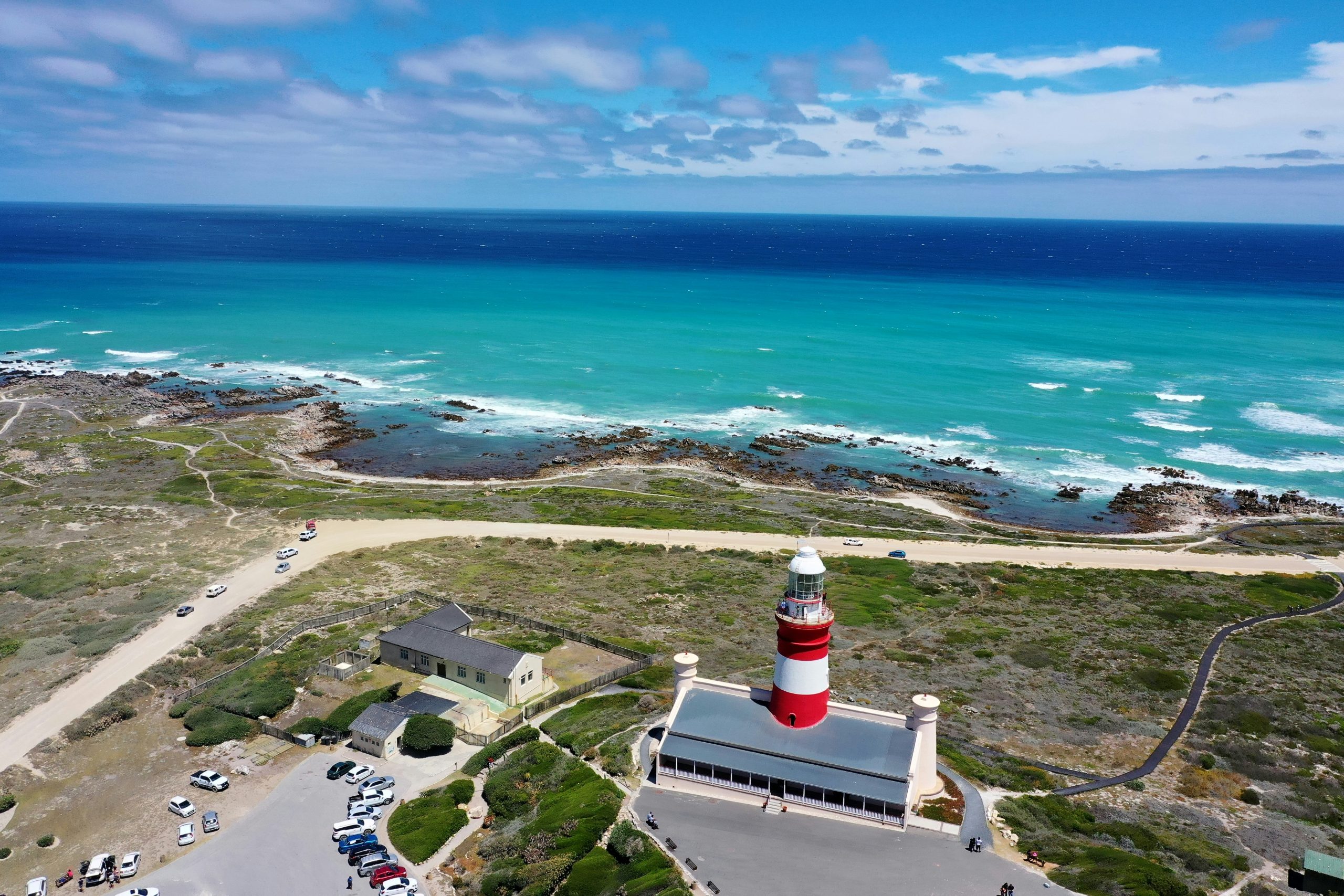
In a book I read so long ago that I’ve forgotten what it was, there was a reference to a wind in France that the locals say drives people mad. As a resident of one of the windiest parts of Cape Town, I can relate to this. During summer, including the spring and autumn ‘shoulders’, the southeaster can blow for a week at a time. In wind tunnels formed between buildings on the Foreshore, it can blow you right off your feet. Cycling into it can feel like climbing the steepest hill, and when it blows from the side you literally have to lean into it as you wrestle your bike through the wind.
No-one has ever got around to naming it, in the same way that the world’s famous prevailing winds have names, like Mistral or Sirocco. The Wind is as close as our southeaster gets to a name and it affects the greater Western Cape, driving cool air inland from the ocean that lies to the south. Even Robertson, about 100km from Agulhas as the crow flies, can be chilly on summer nights thanks to this wind.
First established as a Moravian mission in the early 19th century, Elim is roughly 20km from the Agulhas coast. The wind that cools vineyards 100km north, is delivering the full force of its maritime influence here.
When wines from Elim were first released about 30 years ago, I was an enthusiastic supporter. It was particularly interesting to me how the white wines, specifically sauvignon blanc, aged.
So, when one of our favourite wine wholesalers distributed a list of odd lots they were clearing, my curiosity was piqued by a 2017 blend of Semillon and Sauvignon Blanc, as well as a 2018 Semillon, both made by Trizanne Barnard. Given the unknowns when buying nine- and eight-year-old white wine, I ordered just three of each.
I have come to rue this error.
We first opened the 2017 blend, the experience of which I’ll remember for a long time. It was so full of life I can imagine it still being delicious as a ten-year-old wine. The purity of the fruit, with its development after nine years in bottle, was nothing short of magnificent. Key to the whole experience was the acidity, also evolved thanks to time in bottle.
It’s the kind of wine that could be shown to the world’s wine writers/cognoscenti as an example of the quality of mature South African white wines.
The 2018 Semillon was similarly in great shape; a truly delicious wine. Having opened the blend first, what struck me was the difference in acidity. At this stage of its life it’s a soft wine with rounded fruit filling the mouth.
In my excitement, the first thing I did the following morning was to email Trizanne, and received the following response:
I clearly remember the 2017 vintage. Having completed nine vintages in Elim by then (and 15 in my total young winemaking career then), 2017 was a much drier year in Elim. If you recall we had the severe drought in 2015 – which lingered for a few years. Although Elim didn’t necessarily experience that drought as much as other parts of our wine areas, the area still had much drier conditions, which boded well for the 2017 vintage. I recall walking through the vineyards and deciding to bottle the Semillon on its own for the first time that year. I knew it whilst picking the grapes; sometimes one just knows, early on, if the year will be exceptional. So the blend followed my standard modus operandi, and the Sauvignon Blanc’s acid ensured longevity in the bottle.
The 2018 returned to more normal conditions for Elim, cooler and slightly wetter. However, the Semillon still fared well on its own, though it lacked the acidity support from the Sauvignon Blanc – as time in bottle continued. It is interesting to note that that specific block of Semillon actually had some leafroll – not too severe at the time – but it prevented me from picking super ripe, maintaining more acid than one would expect from Semillon. Reason for it to also last longer in bottle.
Another noteworthy fact about Elim, and specifically the whites from Elim, is that they need a lot of time in the bottle – and if one is patient enough, the magic starts to unfold. That said, 2017 was a very special year, and part of me regrets that I released it so early. It was a fluke—I ‘lost’ about 200 bottles in the warehouse; they were packed in a bin and I only discovered them a few years later, hence the re-release of the 2017 bottles.
Wine gives voice to a landscape, in the best cases producing wines that bring delight, pleasure and reflection. If we are fortunate, we are exposed to transcendence, as in the case of Trizanne’s 2017 blend. In the sharing of wine there is a kind of communion, a fellowship exchanging our experiences of the wine as we drink together. This is good for us as humans.
It’s a sad thing that health fears are causing us to drink less. Of course, it is true that alcohol is a toxin, and it has effects on health. However, there is also a level at which wine is an expression of a bunch of fantastic things, and we need the market to continue to support that. I am part of the cohort that is drinking less, but these two wines were a great reason for me to have been drinking that night.
Of course, the wind isn’t all that makes Elim’s wines taste the way they do. There is also the soil, with its variations across the region (not to mention on individual farms), there are the viticulturalists who tend the vineyards, and finally the dreamer artist-scientist winemakers who take the wine through fermentation and maturation having guided the care of the vineyards.
It’s a shame that wines like this should be dropped into the same category as other beverages that contain ethanol. I’m drinking less and I’m drinking more selectively, but wines like this are a reason to not give up entirely.
In any case, when The Wind is keeping us indoors, what else is there to do?